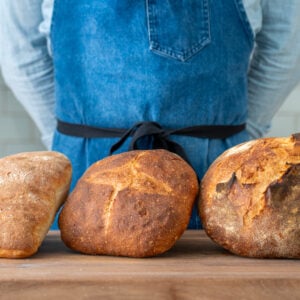
The Easiest Actually Good Bread (1 Dough 3 Loaves)
This is an updated and much easier to execute version of my original 1 dough 3 loaves recipe. It focuses on one beginner bread dough that can be used to make three different loaves of bread of increasing (but still simple) complexity. This version 2.0 recipe makes a few tweaks that will be easier for beginner bakers to execute and produces a fool proof result!
Ingredients
POOLISH INGREDIENTS:
- 150 g water (room temperature)
- 1 tiny pinch instant y east
- 150 g bread flour
DOUGH INGREDIENTS:
- 250 g warm water, approx 86°F/30°C
- 2 g instant yeast
- 300 g ripe poolish, see poolish instructions
- 12 g salt
- 400 g bread flour
- 50 g whole wheat flour
Instructions
Make the Poolish
- In a small bowl, combine the room temperature water, a tiny pinch of yeast, and bread flour.
- Stir to combine, cover, and let it ferment at room temperature for at least 4 hours, but preferably 24 hours.
Make the Dough
- In a medium bowl, mix together the warm water, instant yeast, and all of the ripe poolish.
- Add the salt, bread flour, and whole wheat flour to the bowl and stir with a sturdy spoon until you can no longer move the spoon through the mixture.
- Switch to using a wet hand to squeeze and massage the dough until there are no longer any dry spots and everything is evenly combined.
- Cover the bowl with a lid and ferment at room temperature for 30 minutes.
- Perform a strength building fold by pulling out a handful of the dough on one side and folding it over to the other side of the dough. Rotate the bowl a few degrees and repeat about 7 more times, rotating the bowl after each fold.
- After the folds, grab the ball of dough around its side/bottom with one hand, picking up the ball while rounding and rotating it, then setting it back down to create tension across the top. Do this several times.
- Cover and allow to ferment at room temperature again for another 30 minutes. After 30 minutes repeat the strength building fold and rounding.
- Cover and ferment at room temperature for 60 minutes. As this point you've fermented for 2 hours total. When you check back after this 60-minute ferment, the dough should have doubled in size.
I use a 5qt stainless bowl for all of my bread mixing and in this case, proofing (linked in the gear section below). It's super durable and inexpensive.
Watch my YouTube video embedded in this recipe card for visual instructions of the folding and rounding process.
SHAPING YOUR DOUGH INTO A LOAF
LOAF 1: Simple Ciabatta Style Loaf
- Flour your work surface and gently flip the dough out onto it.
- Flatten the dough slightly with a flat hand and pop any air bubbles.
- Shape the dough into a rough square then cut the square in half to create 2 equal rectangles.
- Transfer each loaf onto a parchment-lined sheet tray, cover with a kitchen towel or another sheet tray, and proof at room temperature for 60 minutes.
- Bake the loaves for 20 minutes in a well-preheated 480°F (250°C).
- After baking, let the loaves cool slightly before slicing with a bread knife.
LOAF 2: Darker and Crustier Loaf
- Flour your work surface and gently flip the dough out onto it.
- Shape the dough into a rough square.
- Cut the dough in half and shape each half by pulling out both sides, folding them over each other (like you would a letter) and gently degassing any large bubbles.
- Flip the dough over onto the folded side and tidy up to ensure everything is nicely tucked in.
- Transfer both shaped loaves onto a parchment-lined sheet tray. Cover with another sheet tray and let them proof for 60 minutes.
- Preheat the oven to 480°F (250°C) with a dutch oven or lodge combo cooker inside for 30 minutes.
- Slice the parchment paper in half (between the two loaves) and carefully lower 1 loaf with parchment paper into the pre-heated dutch oven using the parchment paper.
- Cover with the lid and bake for 20-22 minutes.
- Remove the lid and continue baking uncovered for another 10-12 minutes until the loaf is deeply golden brown.
- Repeat the process for the second loaf.
You can bake both loaves at once if you have 2 dutch ovens
LOAF 3: The Big Dog Boule
- Flour your work surface and gently flip the dough out onto it.
- To shape the dough, grab a corner/side piece of the dough and pull it about 60% of the way across to the other side of the dough. Grab another side/corner of the dough next to the first, and fold it across again. Repeat all the way around the dough. You'll do this between 7-9 times in total, popping any big bubbles that form along the way.
- Flip the dough ball over so that the seam side is down against the work surface. With your hands on either side of the dough, roll the dough on its seam side while tucking it up underidself to seal it and create tension across the top of the dough.
- Grab a medium sized bowl that's just bigger than the dough ball you just made (I've linked the 5qt bowl I use in the gear section below). Line the bowl with a thin kitchen towel and dust the towel with a mix of wheat and all purpose flour. Transfer the dough ball to the floured towel-bowl, seam side UP, tucking the seam once again to better seal.
- Fold the towel over the dough and let it proof at room temperature for 45-120 minutes (depending on the temperature of your house) until it has doubled in size. The warmer your house, the shorter the proof. The cooler your house, the longer you'll need to proof. When properly proofed, the dough should indent then slowly spring back when you poke it.
- Preheat your oven to 480°F (250°C) with a dutch oven inside for 30 minutes
- Place a generous dusting of semolina flour or fine cornmeal in the dutch oven to prevent sticking.
- Carefully flip the shaped loaf into the dutch oven (seam side DOWN) and score the top with a few cuts or slices.
- Cover the dutch oven with the lid and bake for 18 minutes.
- Remove the lid and continue baking for another 20-25 minutes, reducing the oven temp to 465°F/240°C.
- When deeply browned, transfer the loaf to a wire rack to cool before slicing.
Check out my YouTube video embedded in this recipe card for visual instructions for this process.
Notes
For the best results, I highly recommend using a kitchen scale for weighted metric measurements (grams) as opposed to volumetric.
 Like this? Leave a comment below!