

This post contains affiliate links. Please see our disclosure policy.
Tender beef smothered in a flavorful Guinness gravy. All tucked inside a flaky pastry crust. This is hearty English countryside cooking made approachable for the home cook.
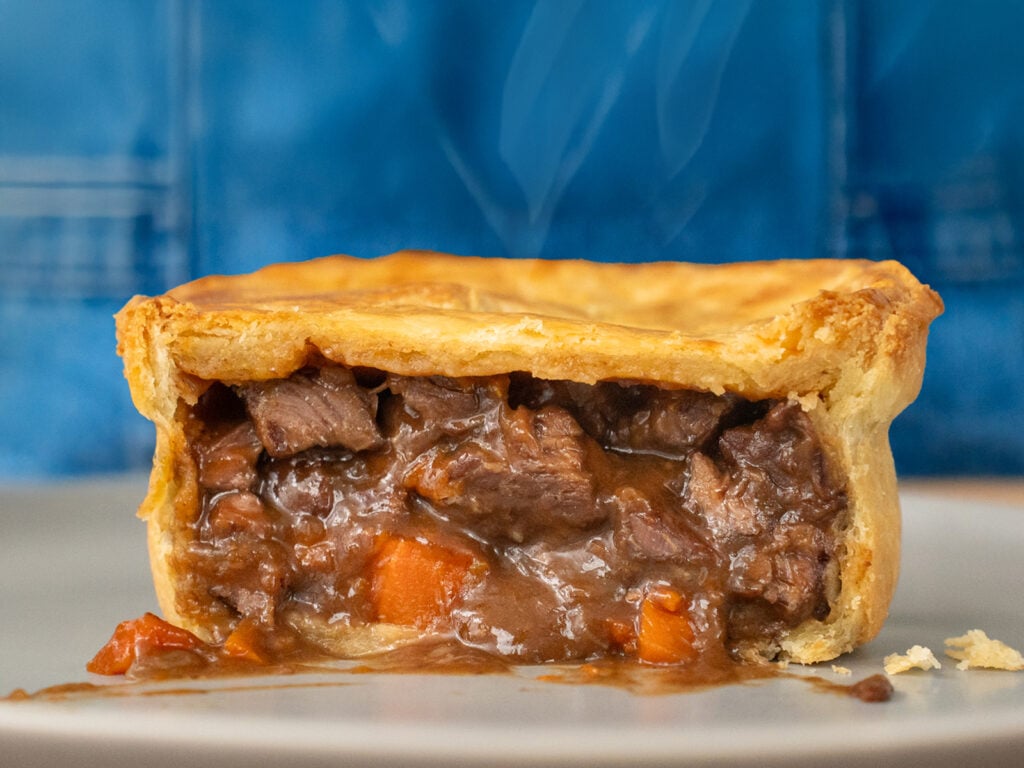
Table of Contents
Why This Steak and Ale Pie Recipe Delivers
A well-made steak and ale pie is an edible sculpture. The interplay of flaky, rich pastry crust with succulent beef and dark gravy is one of England’s greatest achievements.
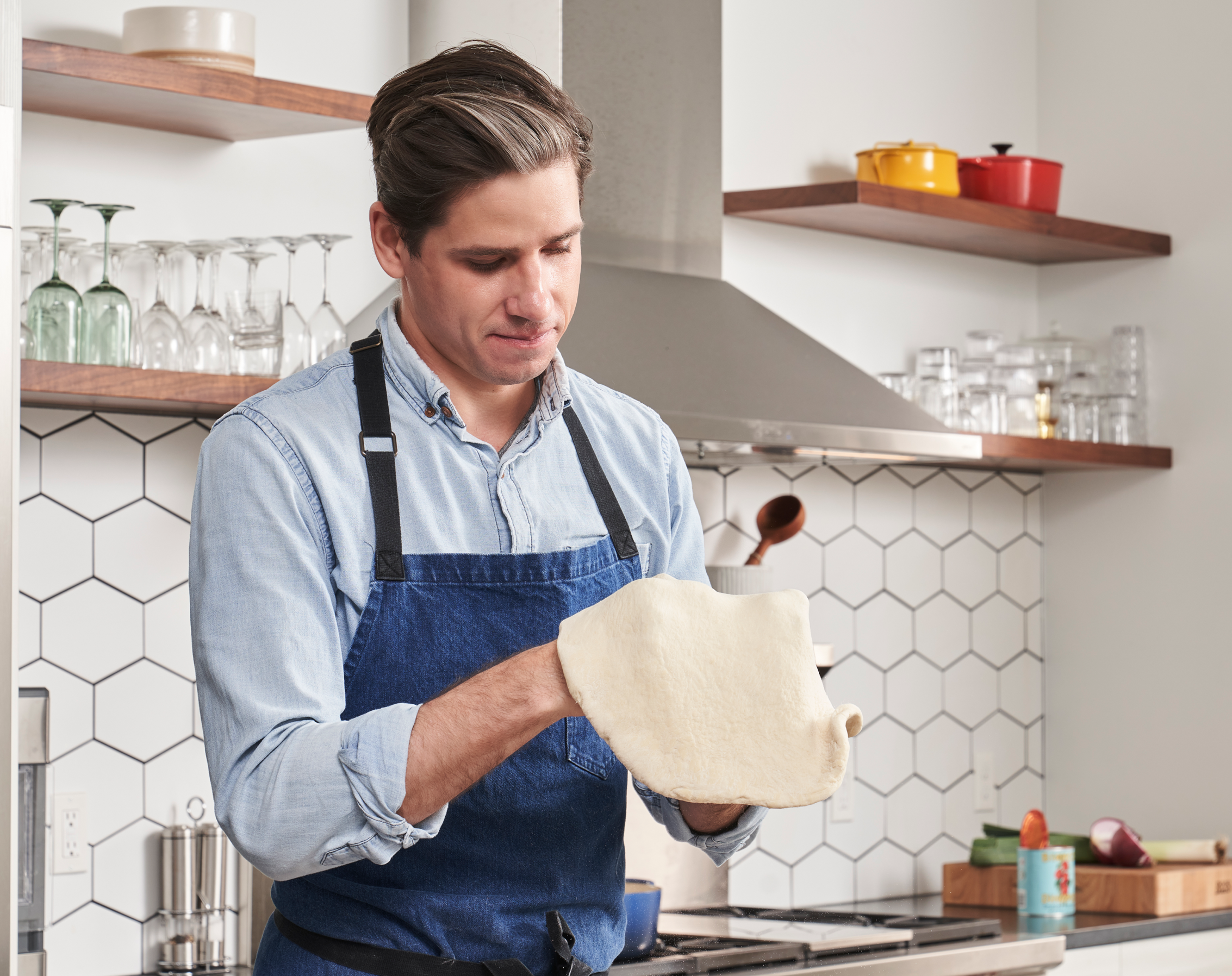
BUT, this is not a dish you can sling together on a whim. Because of its structural demands, you need to get each component just right. Otherwise, you’ll have crumbled slop on your plate, which doesn’t hit quite the same. To make this work, I opted for a forgiving pastry dough enriched with cream cheese, for flavor and pliability (more on that below). I’ve paired that rich, pliable crust with a process borrowed from bread baking to make rolling out the crust easier, even for beginners.
I also thicken the beef sauce two ways (reduction and good old-fashioned roux) to ensure that it glazes the meat and doesn’t ooze out once the pie crust has been breached. The result is a unified, refined experience that I think any pub-goer in the English countryside would be happy to tuck into.
Brian’s Pro Tips
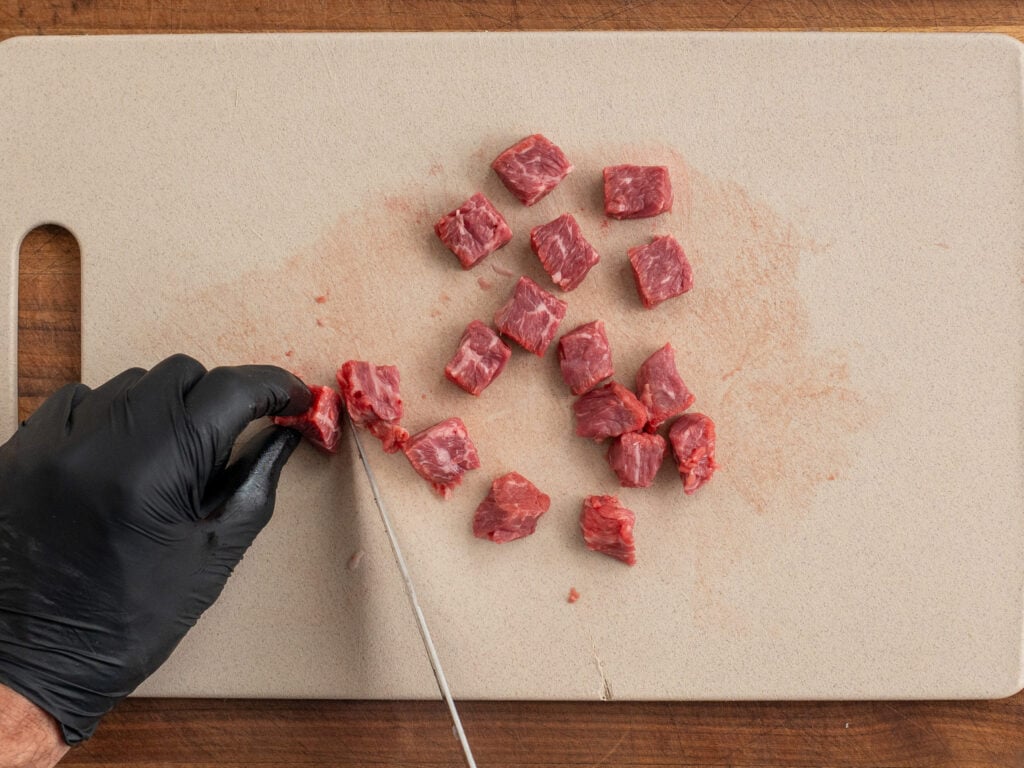
Small Beef – Stew sized chunks are great on their own in a bowl, but in a pie they leave lots of empty space, and you can only squeeze 3-4 pieces into each pastry shell. Half-inch cubes pack in tightly, so every bite has beef in it.
Trim the Fat – Be kind of aggressive when trimming the hard white fat off the chuck. In a pie, there’s no pushing a chunk of fat to the side of the plate with your fork. If you leave too much of it on the meat, the final pie will feel flabby and kind of gross.
Broil Instead of Sear – Getting 3 pounds of beef seared on the stovetop would take at LEAST 2 batches, make a pretty substantial mess from all the oil splatter, and would take at least 25 minutes. Plus, if you crowd the pot, the beef steams gray instead of browning. The broiler browns a whole tray at once and leaves the stovetop free to get the onions started, so it’s faster overall and makes a lot less mess.
Overnight Cooldown – The main reason I do this is flavor. Braises that are allowed to cool completely and rest overnight taste roughly 25-30% better to me than ones that haven’t. In the fridge, the flavors have time to mellow and meld into something deeper and more integrated (This isn’t just a vibe. It has scientific truth to it). I also like that it allows me to split the roughly 3 hours of cooking across 2 days, which makes it much more likely that I’ll tackle this project at all. That being said, you can still get a great result with a one-day braise. Just know that you’ll be missing out on some flavor and are in for a pretty long day of cooking.
Reduce the Sauce Without the Meat – Before this filling can go into a pie, the sauce needs a long, uncovered reduction to get it super inky and thick enough to coat the beef. This takes about 20 minutes, and if you leave the meat and carrots in during that reduction, they’d get hammered. Pull them out with a slotted spoon, reduce the sauce on its own, then fold everything back in at the end.
Let the Filling Cool – Hot beef filling can melt the butter in the dough before it hits the oven. Give the stew a good 20 minutes on the stove uncovered off heat to come back down to a reasonable temp.
Key Ingredient Notes & Substitutions
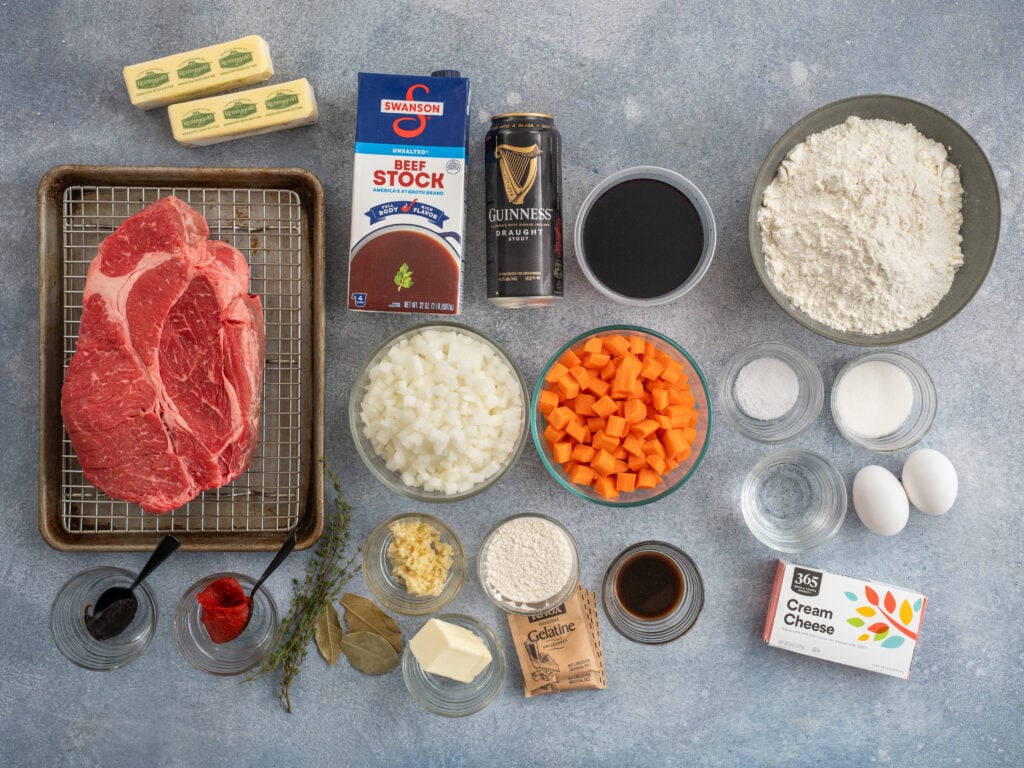
Chuck Roast – Chuck is the ideal braising cut. It’s got enough fat and connective tissue to go tender in the oven, and most other cuts are either too expensive or too lean. Short ribs can work (they’re just pricier), but I wouldn’t use anything else. Buy about 2,000g (a 4.5–5 lb roast) to end up with 1,300g after trimming.
Guinness and Red Wine –I like to use a combo of both because beer alone makes for a bitter stew, and wine alone makes this taste like beef bourguignon, not steak and ale. The beer brings that deep, dark, malty flavor, and the wine brings a fruity sweetness that I think is essential for keeping things in balance. I use Bota Box Cabernet for 100% of my cooking wine because it’s a no-nonsense, wine-flavored wine that comes in little 500 mL boxes that stay good in the fridge for weeks after opening, so I don’t have to waste a whole bottle.
Unflavored Gelatin – This adds the body that store bought stock lacks and helps the sauce grip the beef, so the filling doesn’t spill out once you cut into it. You can find the little boxes of unflavored gelatin packets near the Jell-O. I use this same trick in a lot of my recipes (like my beef stew) LINK HERE to give store bought stock more body.
Cream Cheese – Cream cheese brings a little tang and richness to the pie crust, but it’s main job is to make the dough more forgiving than a butter-only dough. Cream cheese keeps it pliable enough for you to work the dough pretty hard without developing excessive gluten. This is essential because getting dough in the shape of a pie isn’t that easy and might require a couple of tries for the untrained.
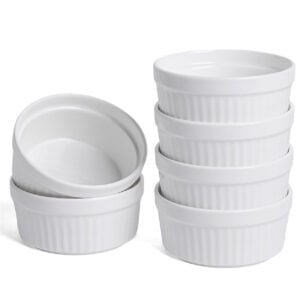
7oz Ramekins – This recipe was developed using a 7ounce, 2 inch high x 4.25 inch diameter ramekin. Mine are from Target (linked here), but these and these on Amazon are very close in size and would also work well.
How to Make Steak and Ale Pie
Day 1: Braise the Beef
1. Prep the Beef.
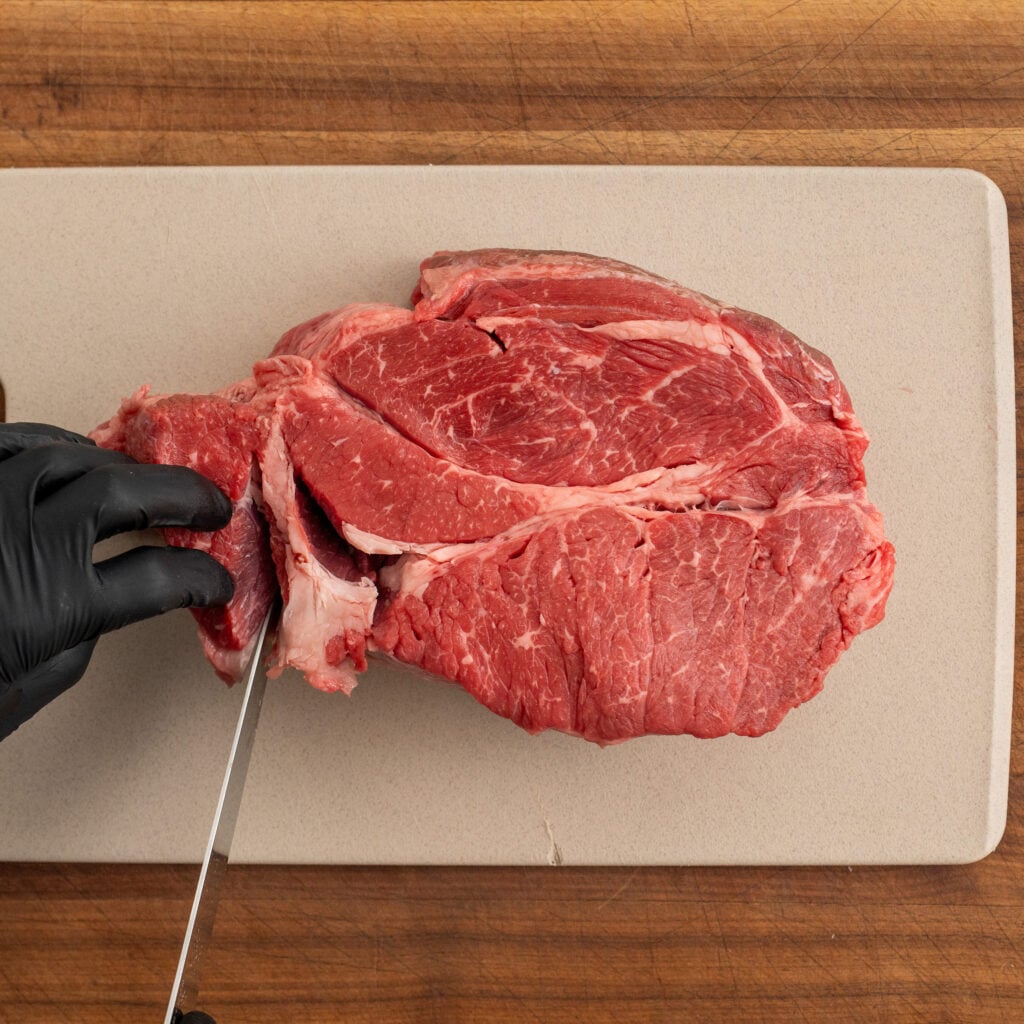
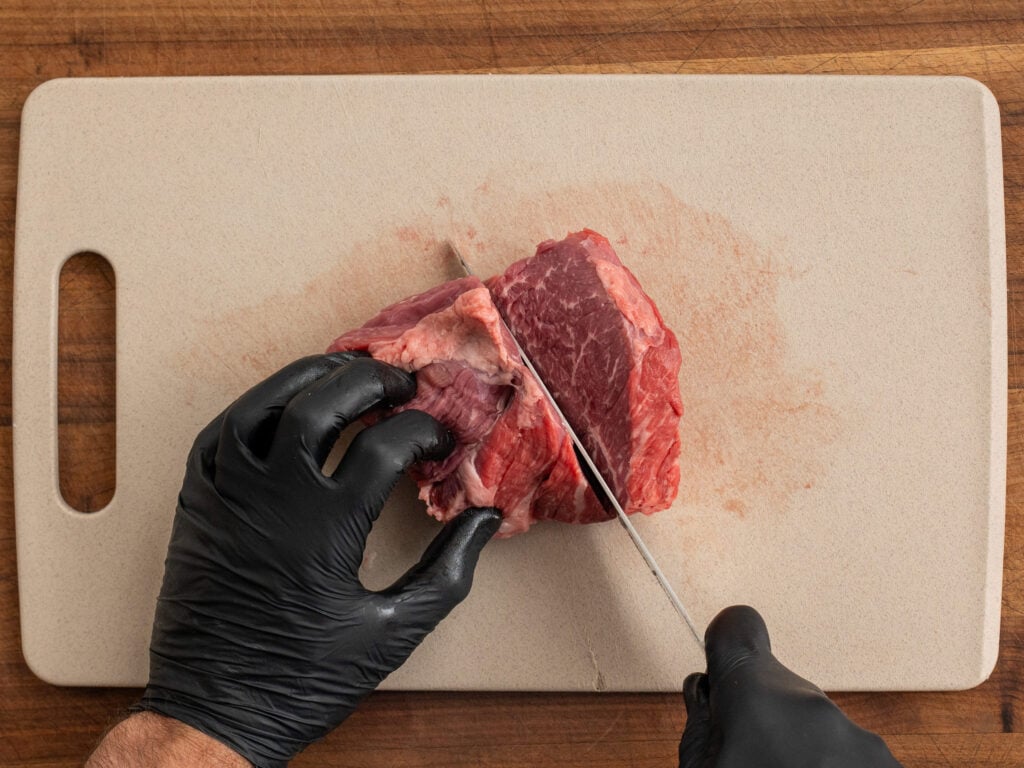
Start with a 4.5-5 lb chuck roast (about 2,000g). Aggressively trim off the hard white fat and any apparent sinew, then cut the meat into ½-inch cubes. You’re targeting about 1,200 to 1,300g of trimmed, diced beef. This might seem like a lot of trim, but the final pie isnt NOT good if there is excessive fat.
2. Season and Broil the Beef.
Toss the beef with 2 strong pinches of salt and 2-3 tablespoons of olive oil, then spread it in an even layer on a sheet tray. Broil at about 6” away from the flame or heating element until deeply browned, about 6 to 12 minutes.
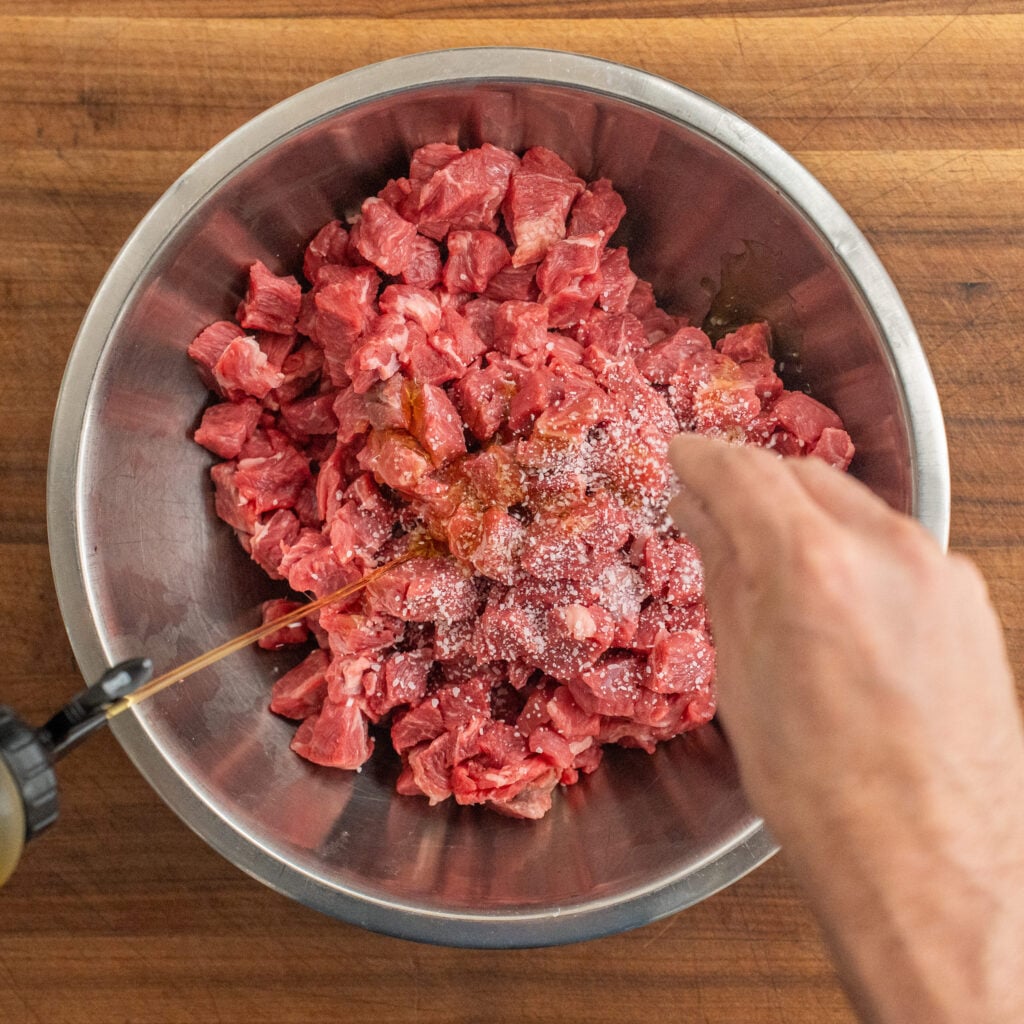
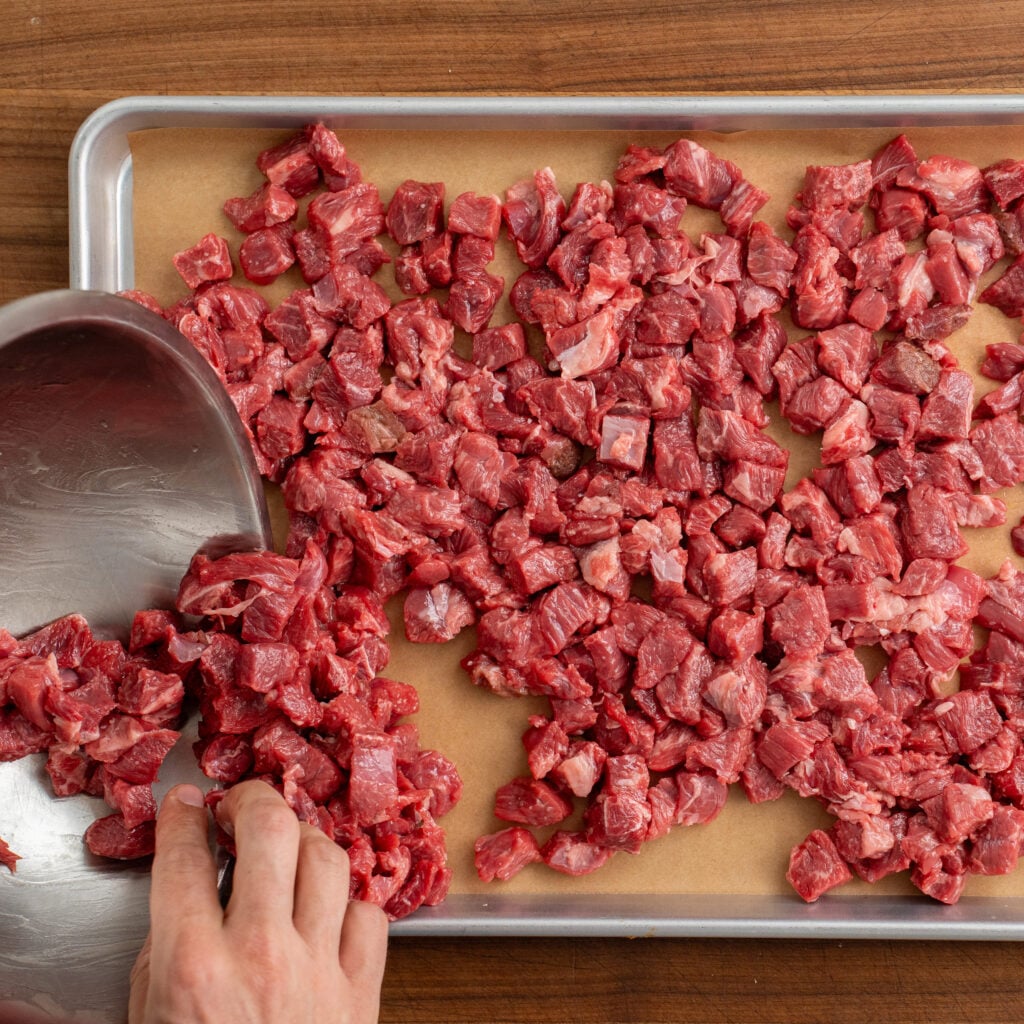
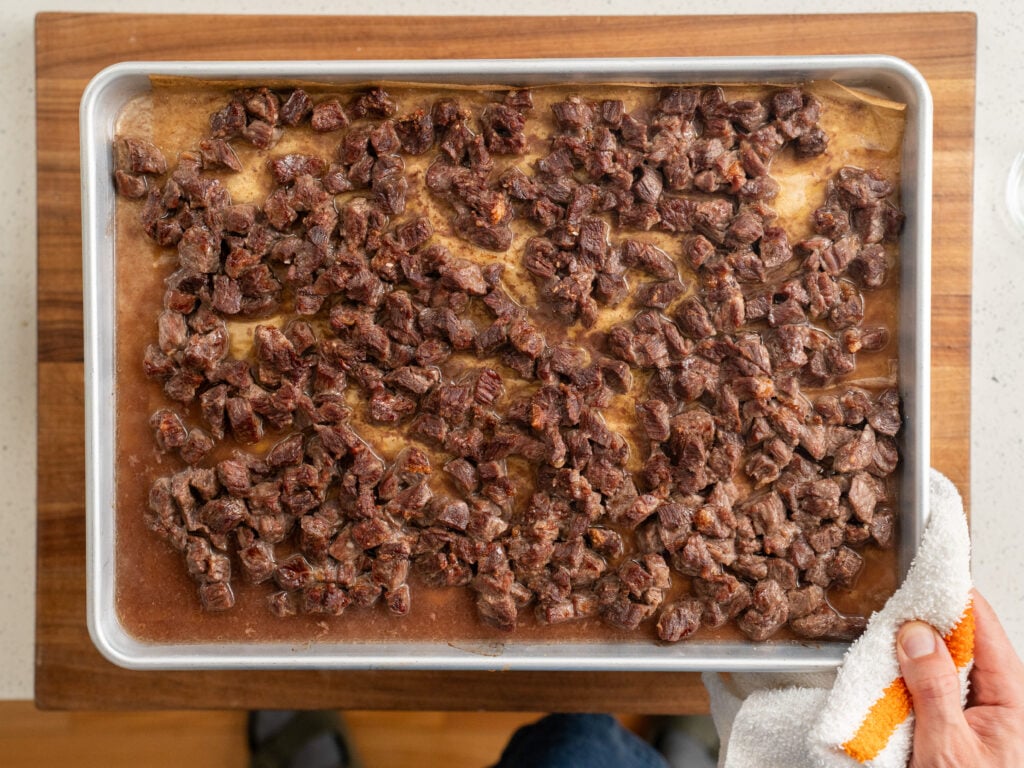
Note: Check in on the beef often during broiling. The time needed for a nice milk-chocolate brown depends on your oven and where your broiler is located. Avoid going SUPER dark as that can dry out the meat.
As the beef broils, feel free to start cooking the onions.
3. Build Aromatic Base.
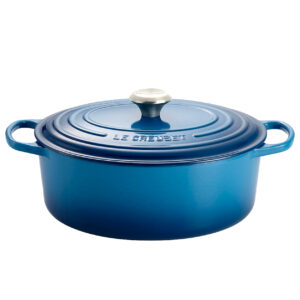
While the beef broils, squiggle 2-3 Tbsp olive oil into a 5-7 qt heavy-bottomed pot. I use this 6.75 qt dutch oven. The pot needs to be oven-safe with a lid because.
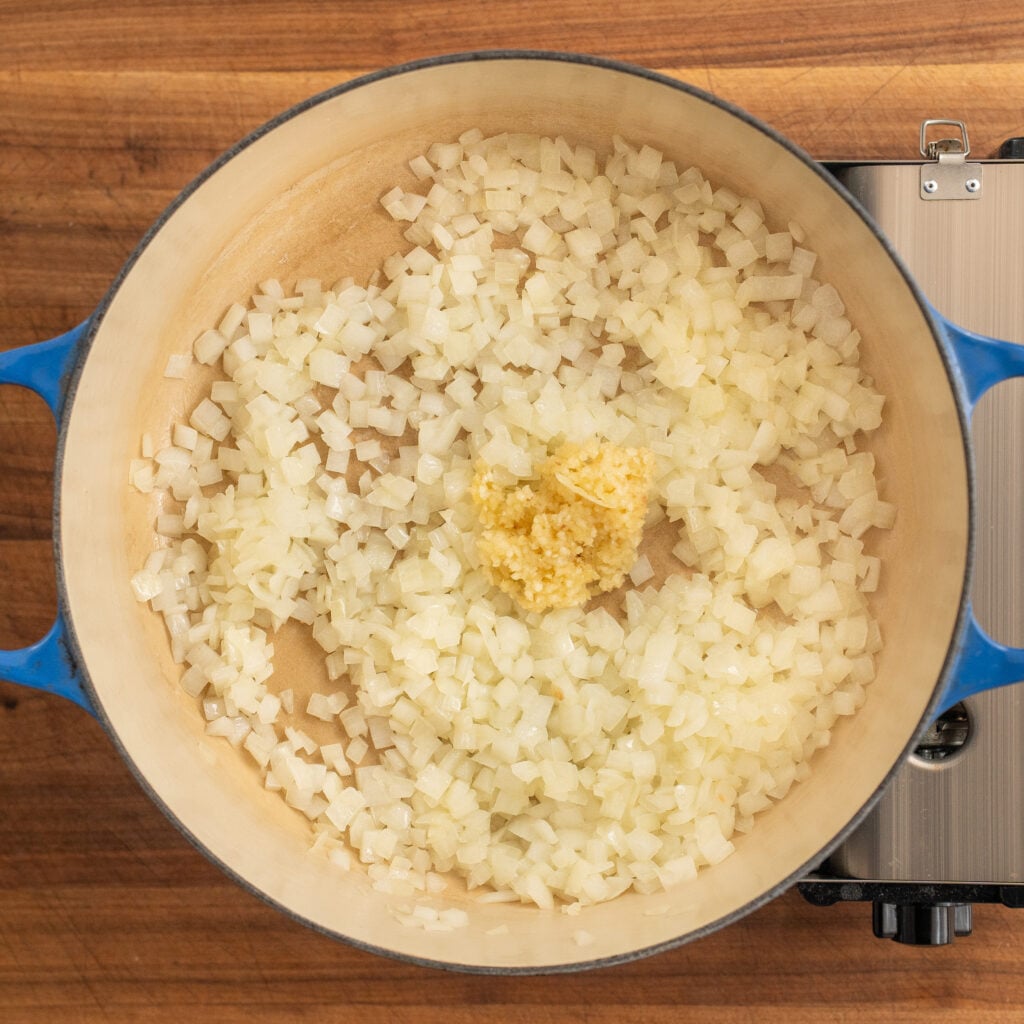
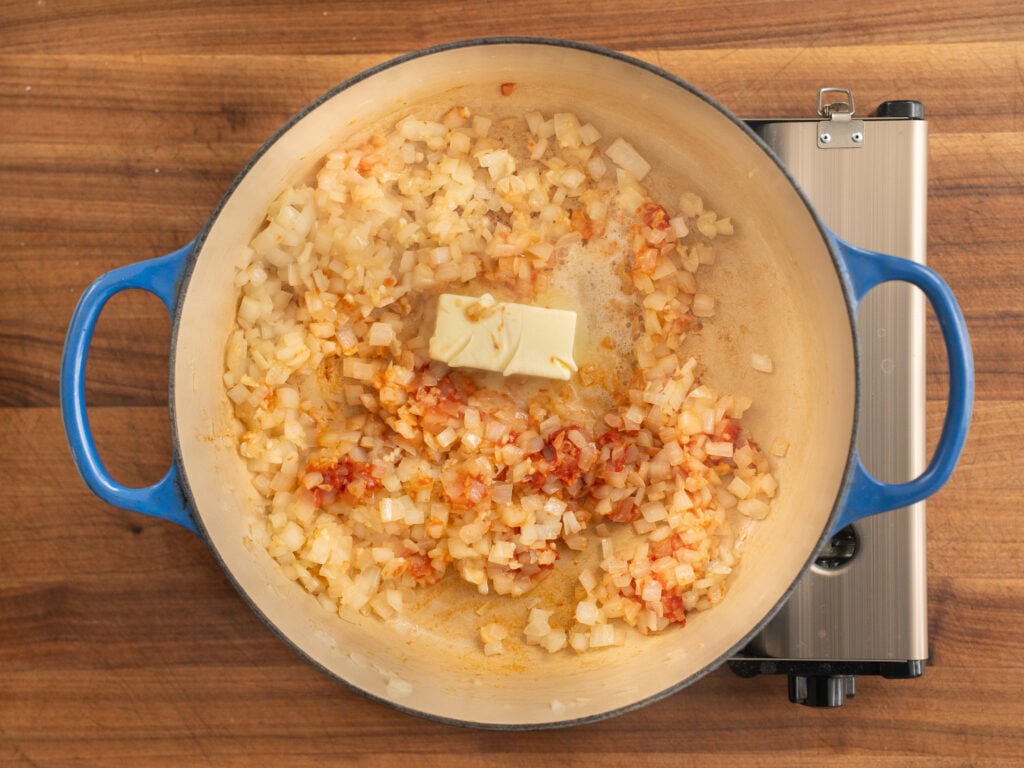
Add 500g small-diced onion and sweat, stirring often, until translucent, which will take about 6-7 minutes. Once the onions are translucent, add 25g minced garlic and cook for about 60-90 seconds, or until it’s fragrant and starting to soften. Then add 40g tomato paste and 60g butter and fry for 1 minute until the paste reaches a rusty red color.
During this time, it’s important to keep things moving. The tomato paste can get grippy and burn if left unattended.
4. Make the Roux and Deglaze.
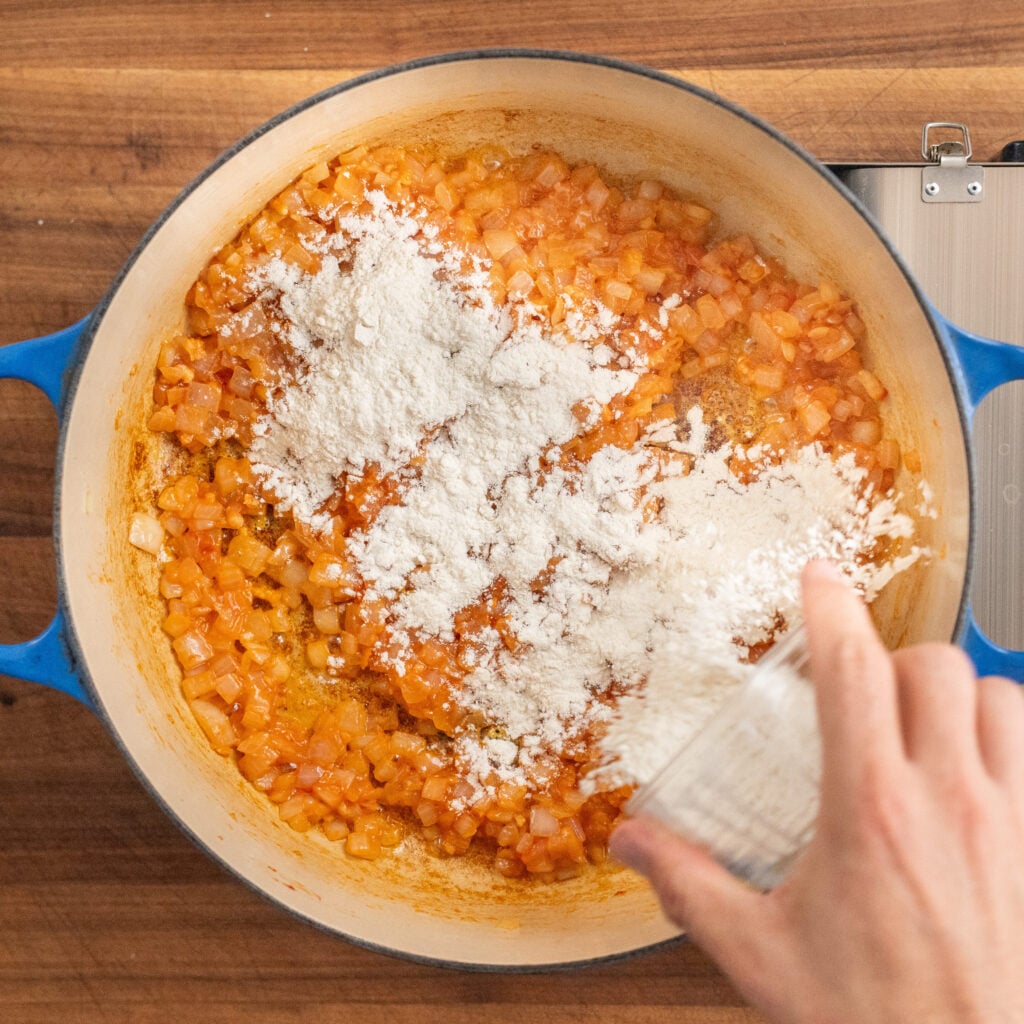
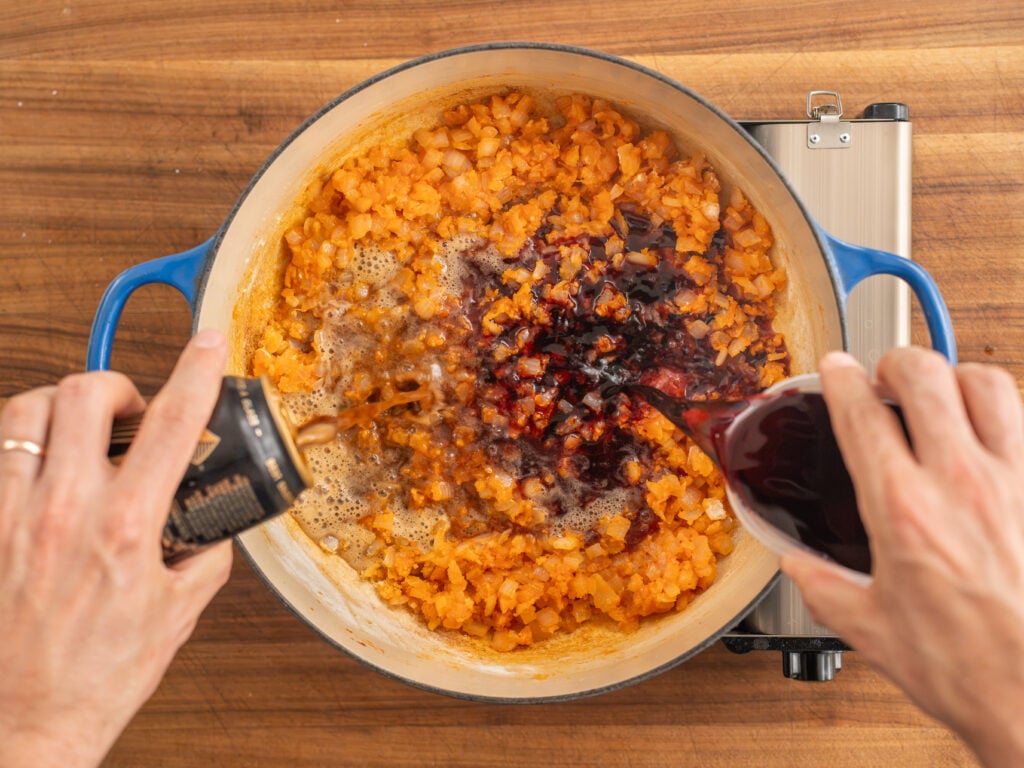
Stir in 60g all-purpose flour and cook for 30 seconds over medium heat until there are no longer any lumps in the flour. Once you’ve got a roux going, pour in 330g red wine and 440mL Guinness (1 large nitro can) while stirring and scraping the bottom of the pot. Bring to a simmer and cook for 2-3 minutes to mellow the raw alcohol flavor.
5. Add in Stock
As the wine and beer come to simmer, sprinkle 21g (3 packets) of unflavored gelatin into the measured 1250g beef stock. Stir until dissolved. Add the gelatin stock, 15g Beef Better Than Bouillon, and 15g Worcestershire sauce. Whisk until smooth and bring up to a simmer.
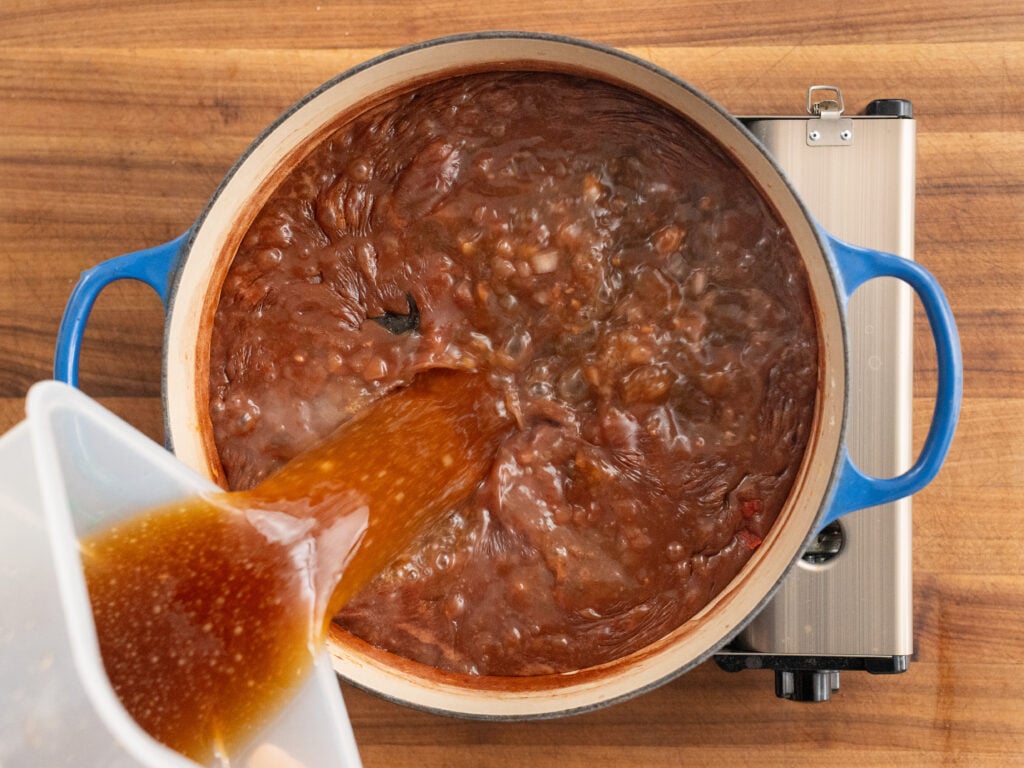
6. Add the Beef and Carrots and Braise.
Once the cooking liquid is up to a spirited simmer, add the broiled beef with all of its drippings, plus 400g carrots cut into a medium-large dice (about the same size as the beef) and return to a simmer. Add the herb sachet by tying 6 sprigs of fresh thyme and 3-4 bay leaves up in a double layer of cheesecloth. Drop it into the pot.
Cover and braise in a 300°F/150°C oven for 80 to 95 minutes, with the rack low enough to fit the pot with the lid on.
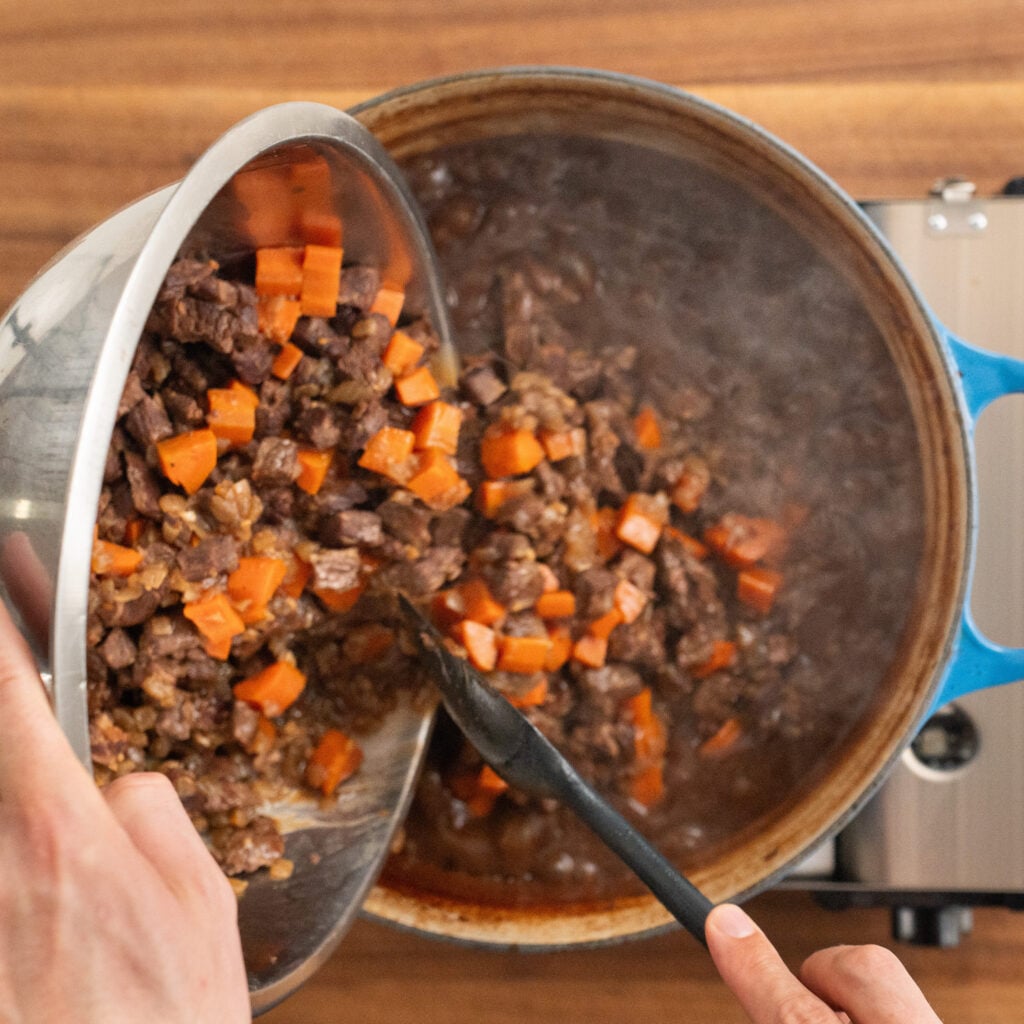
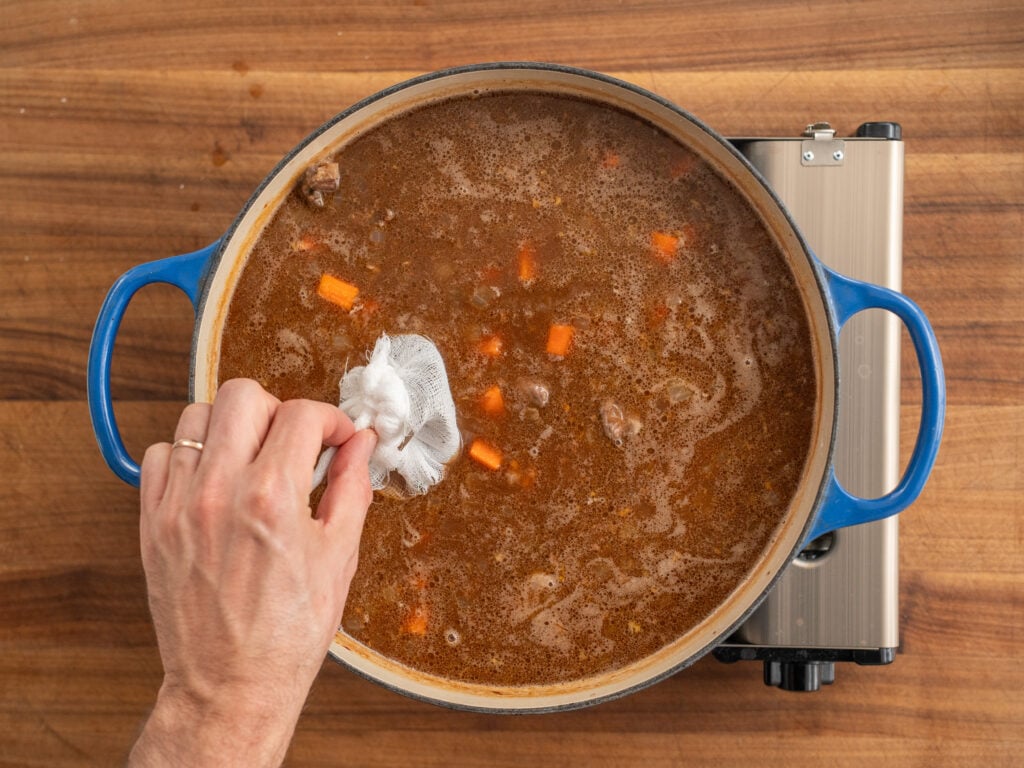
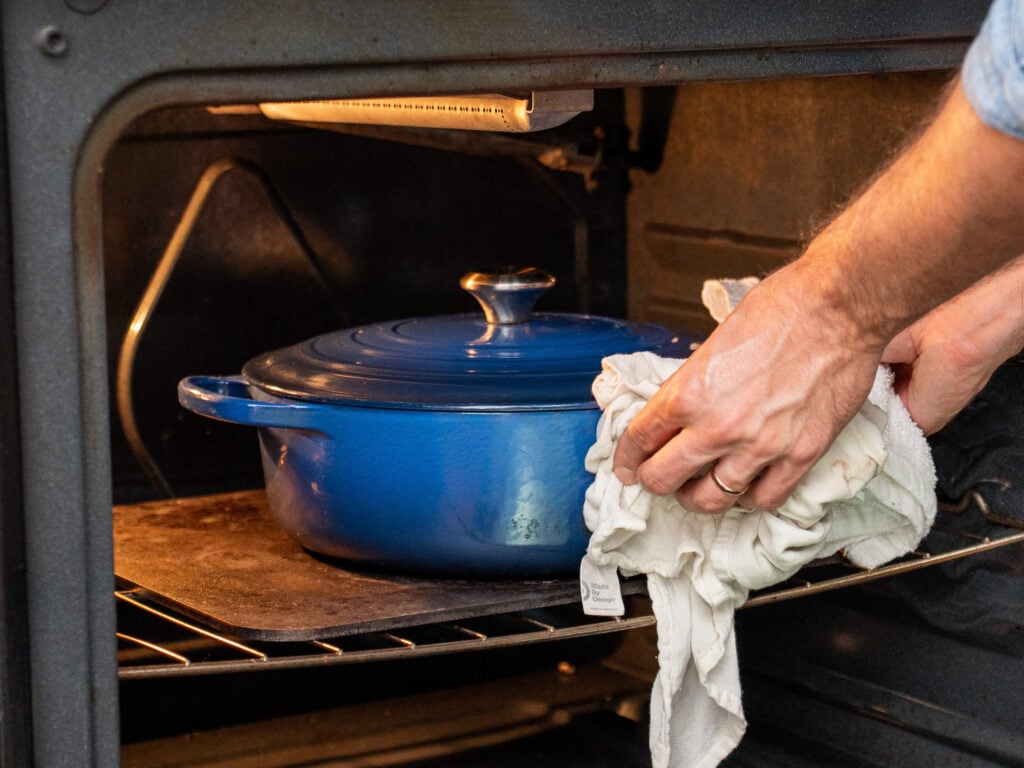
No cheesecloth? Just tie the thyme and bay leaves into a bundle with string. If you toss them in loose, you’ll be fishing woody stems out of your pie.
7. Check the Beef and Chill Overnight (End of Day 1).
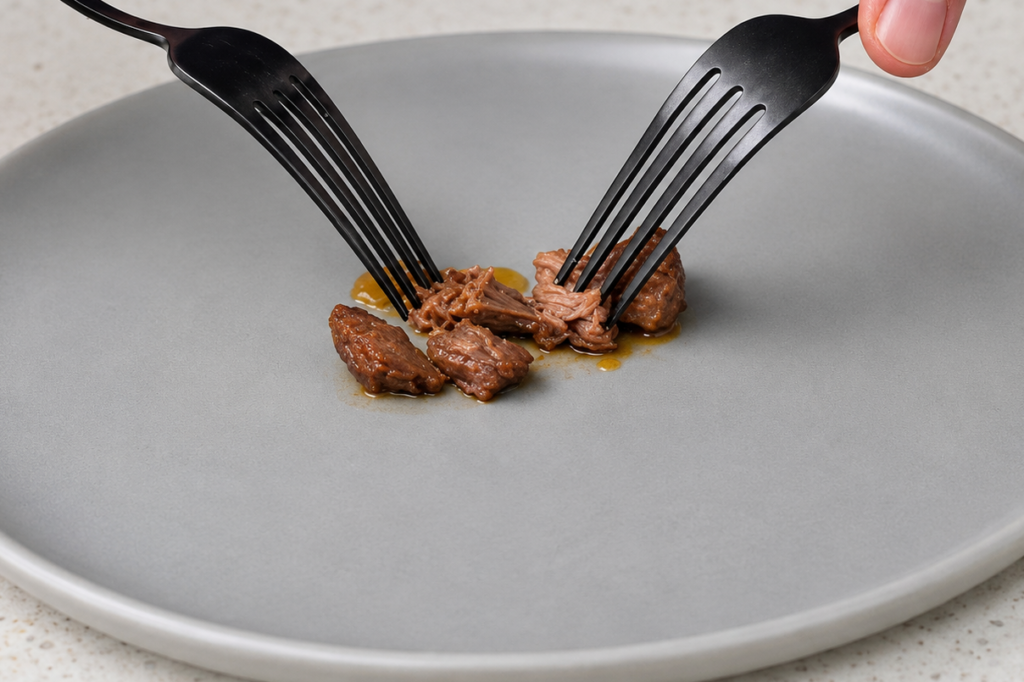
Pull the pot from the oven and check a cube of beef. It should be willing to shred apart, but it shouldn’t completely fall apart on its own. If it’s still springy, give it 15 more minutes in the oven. Don’t push it to falling-apart-tender, though. If it’s too tender it will make for a mushy pie with no meaty bite. Amateurs tend to over-braise meat because they assume more tender is always better. This is not the case. Overbraised meat is not only too soft, it’s usually quite dry.
Cool until it’s no longer hot then cover and refrigerate.
Day 2: Finish the Stew, Make The Dough, & Bake
8. Defat and Reduce the Sauce.
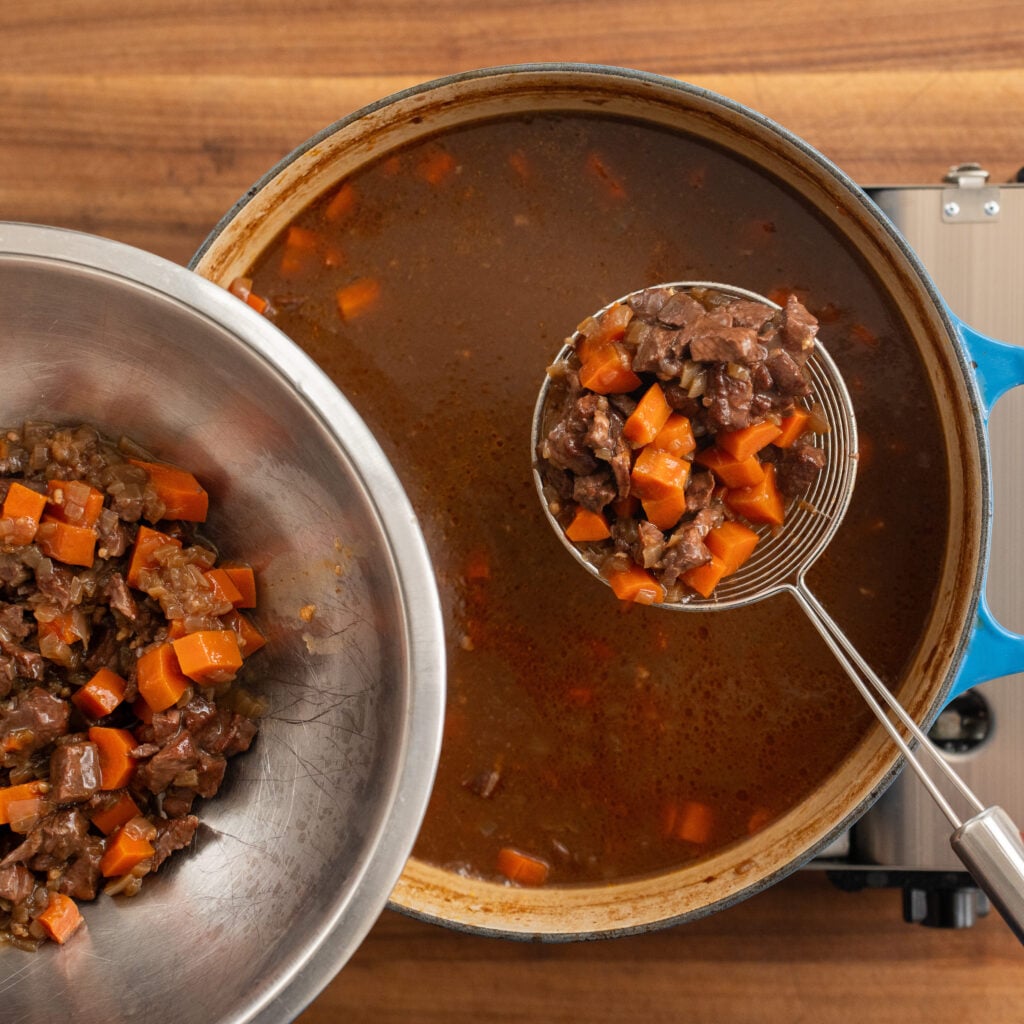
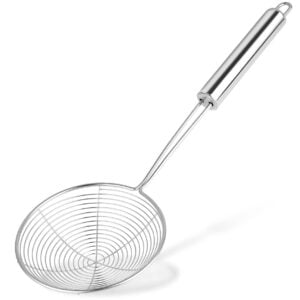
Spoon off and discard most of the hardened beef fat that settled on top of the stew as it cooled. Gently reheat the stew until the liquid has loosened. Remove the herb sachet, squeezing any trapped liquid back into the pot. Use a spider or slotted spoon to transfer the beef and carrots to a bowl, draining them well.
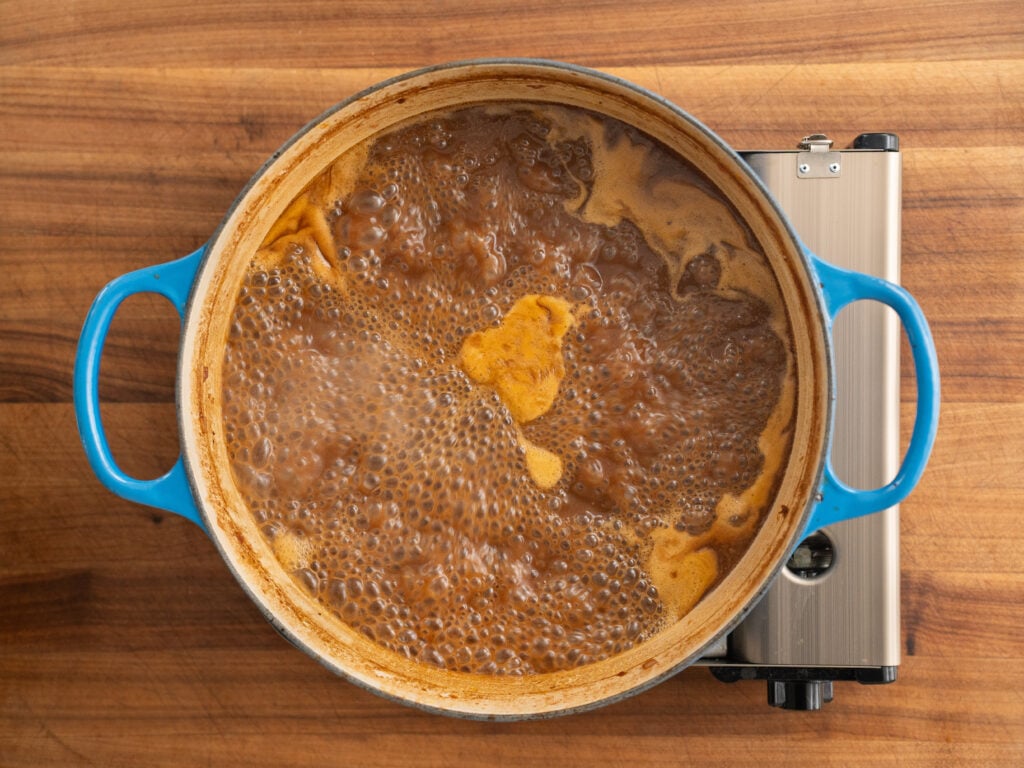
Bring the sauce to a lively simmer over medium-high, uncovered, for 15-20 minutes until it’s quite thick. Be sure to stir into the corners occasionally to prevent scorching.
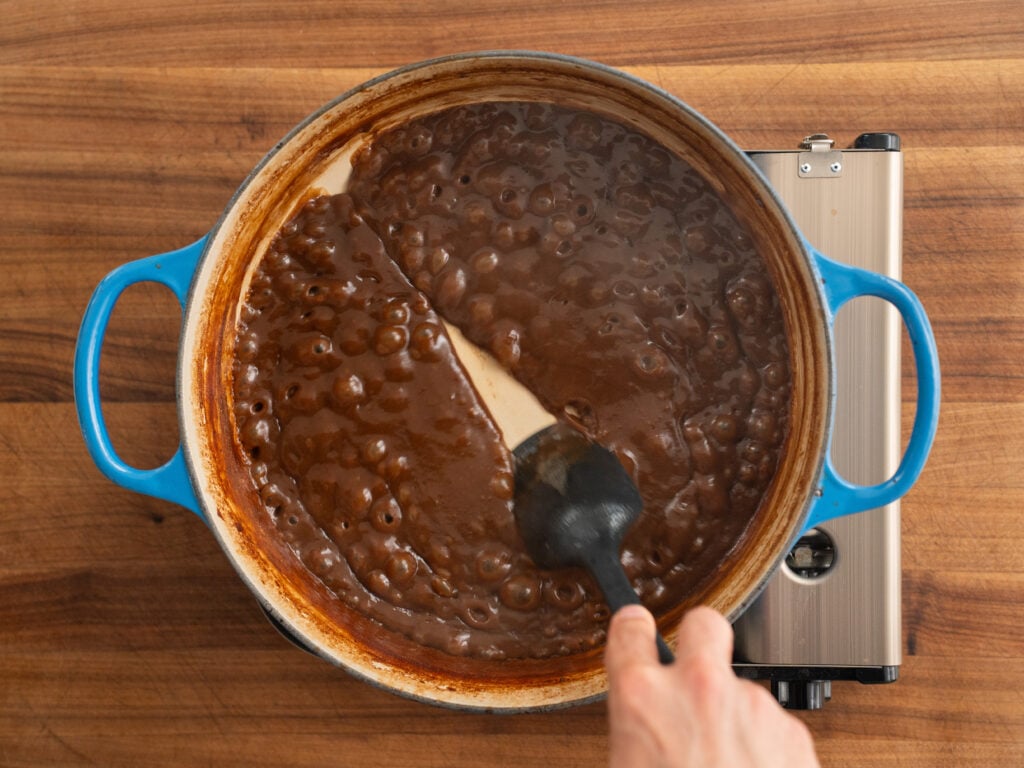
How do I know how far to reduce the sauce? I call it done when I can pass a spatula through the sauce and it leaves a trail for 1-2 seconds. This will be much thicker than a stew you’ll eat on its own. Remember we need this to stay put once the pie is broken into.
What if I reduce it too far? If it goes pasty or starts sticking, splash in a little stock and stir. If it smells scorched, pour it into a clean pot without scraping the bottom.
9. Fold In the Beef and Cool the Filling.
Gently fold the beef and carrots back into the reduced sauce and check the viscosity. Any liquid clinging to them has a good chance of thinning the sauce a bit. If that’s the case, simmer for 1-2 more minutes then taste for salt and adjust if needed.
From here set aside for 10-20 minutes to let cool uncovered while you roll out the pie crust. Stir every 5 minutes until it’s no longer piping hot. Piping hot filling will melt the cold butter in the dough.
10. Make Pie Dough.
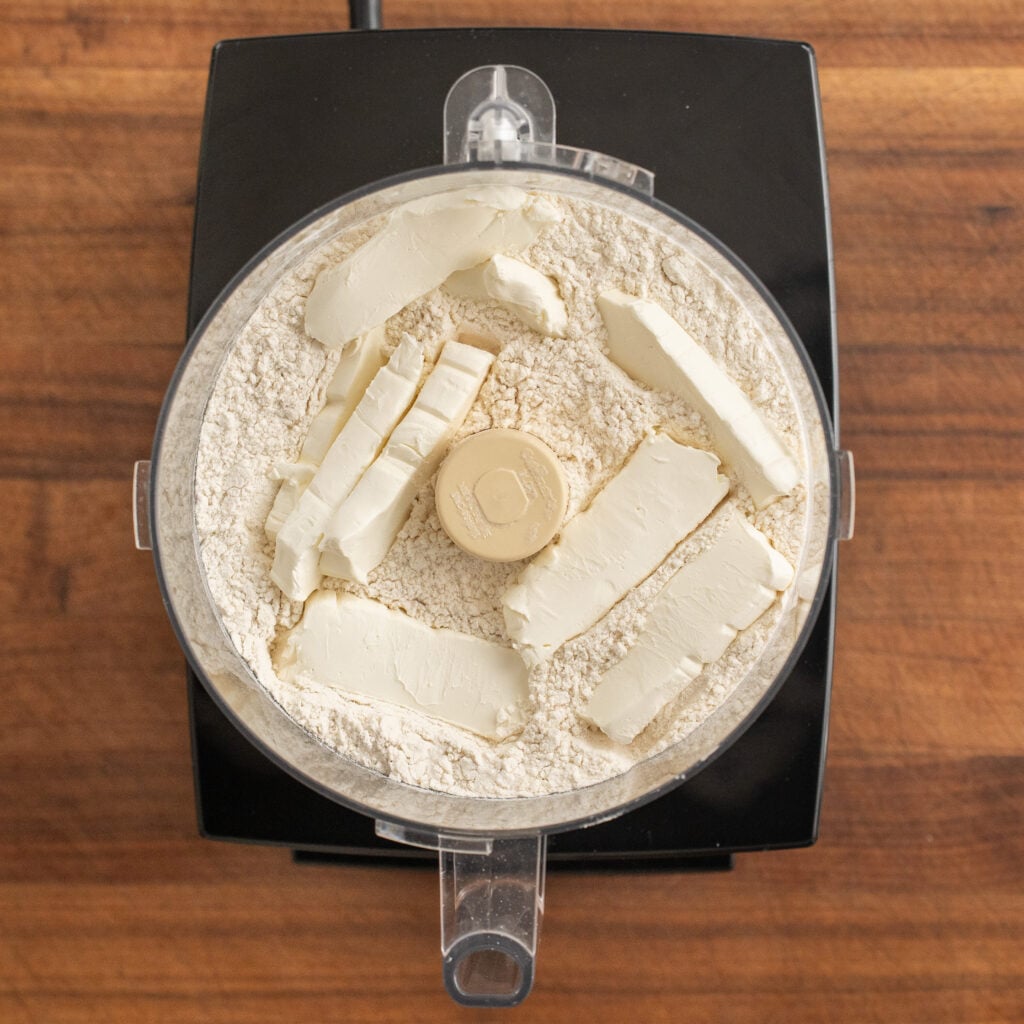
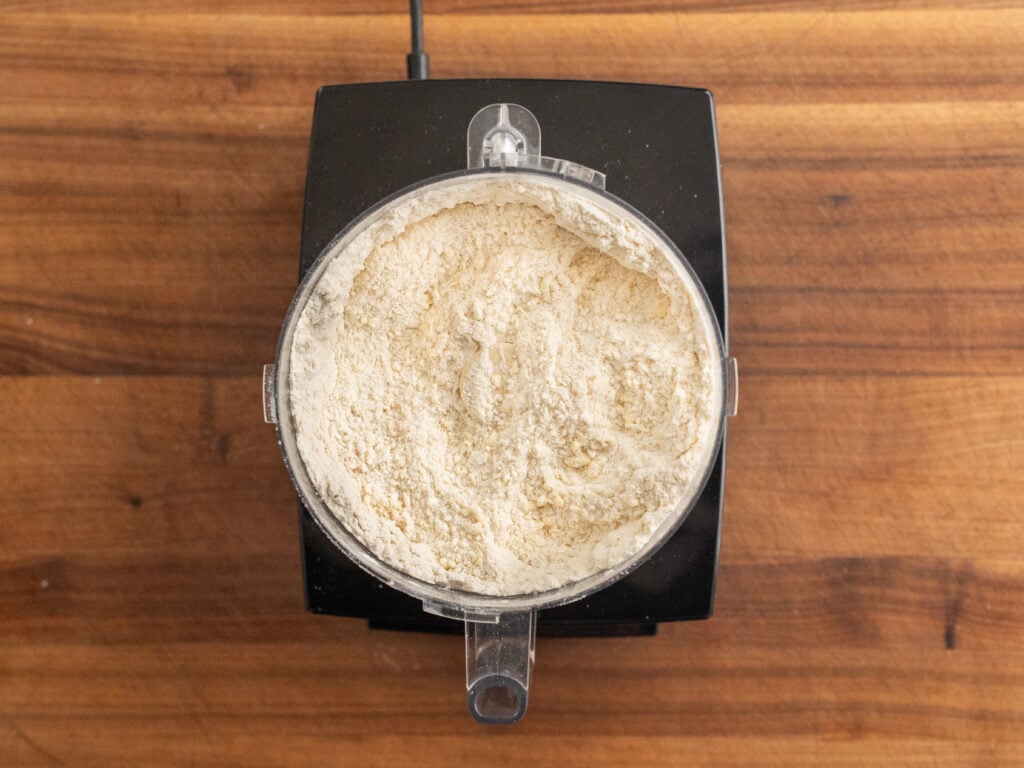
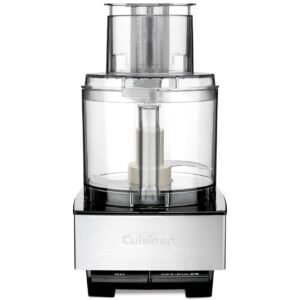
- In a large 14+ cup food processor, combine 575g AP flour, 10g salt, and 35g sugar. Pulse to combine. Add 165g cold diced cream cheese and pulse about 15 times. Next add 245g cold cubed butter and pulse another 10-15 times.
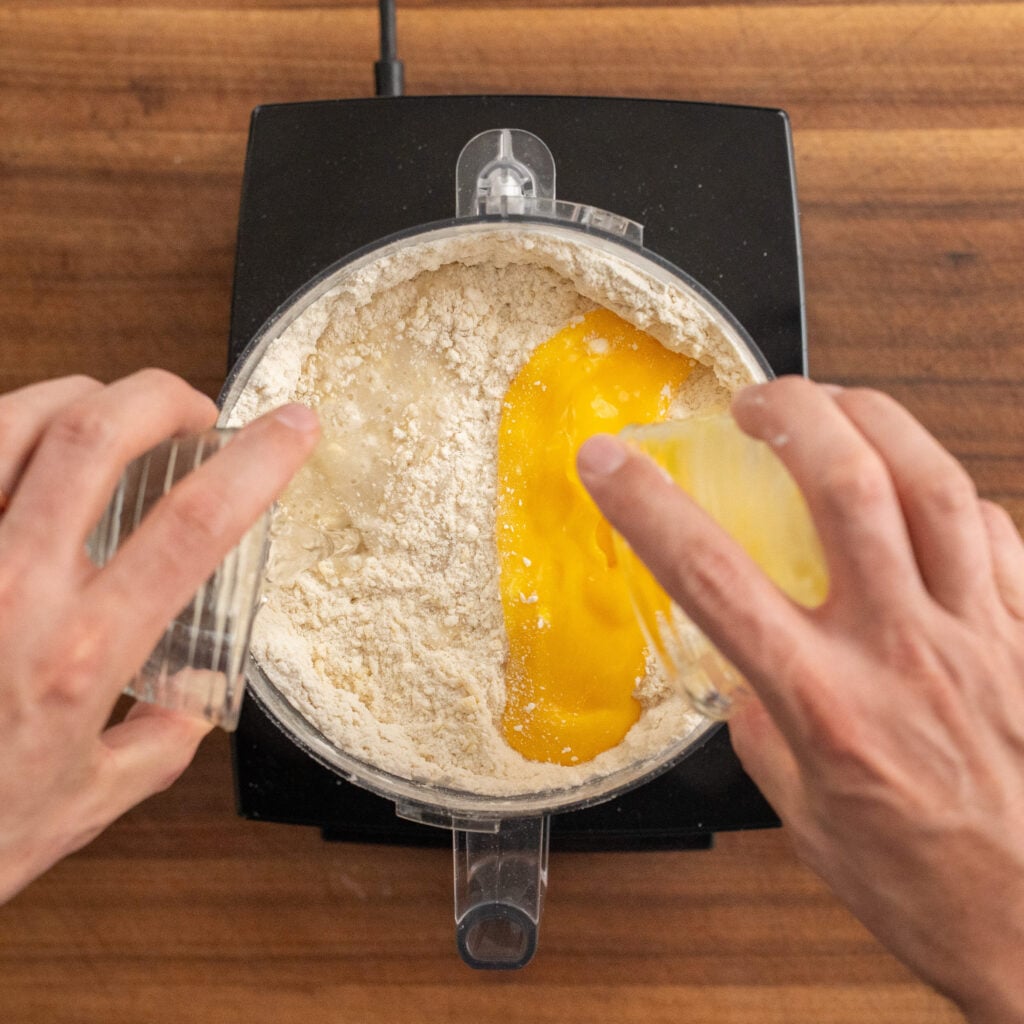
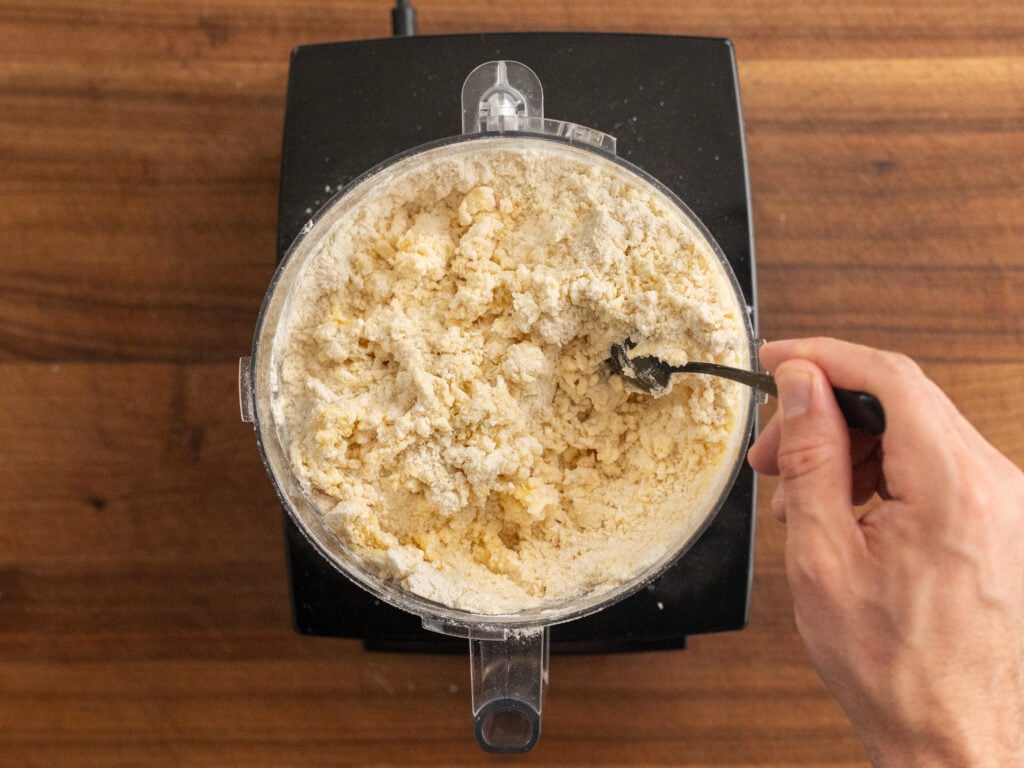
- Remove the lid and distribute 100g cold water and 1 egg whisked with 1 yolk evenly over the flour mixture. Replace the lid and pulse 20-30 times, scraping down sides and bottom halfway through so the wet and dry ingredients uniformly incorporate. Don’t over mix.
- Divide the dough into six 200g (¾ cup) portions, flatten each into a thick rectangle, wrap tightly, and refrigerate for 20-30 minutes before rolling. BTW you can make this pie crust while the beef sauce reduces to save some time.
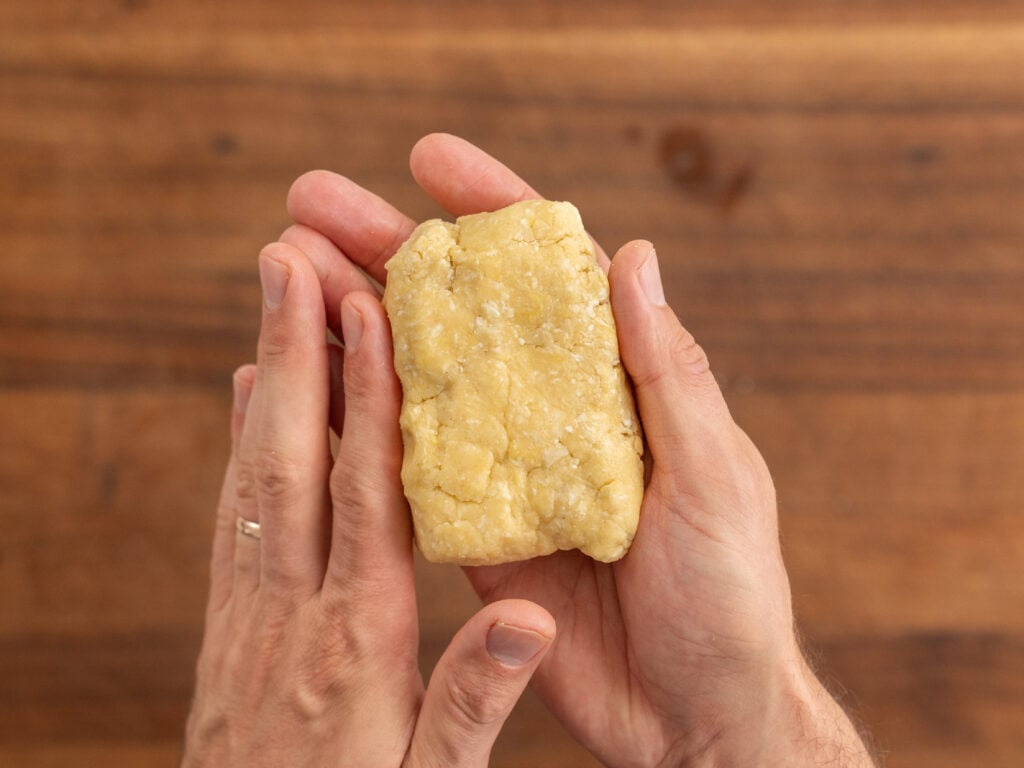
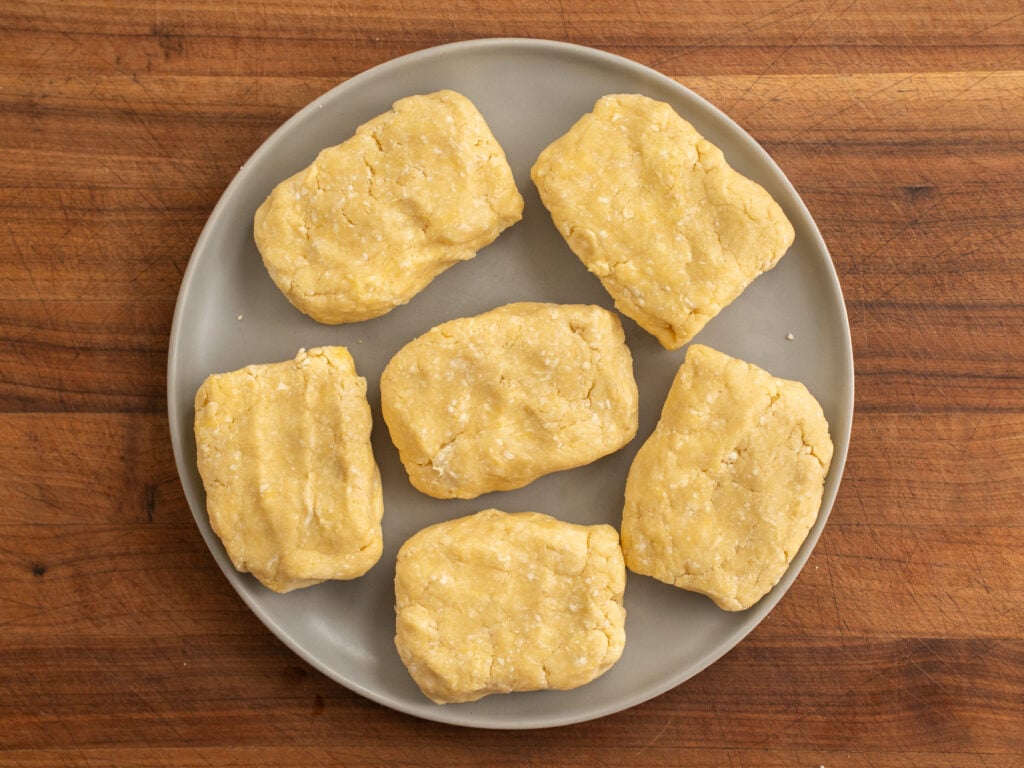
NOTE: If you don’t want to make the dough from scratch, I recommend buying a store-bought pie crust for the bottom and topping with store-bought puff pastry. Alternatively you can put the filling in a cast iron pan like I do for my biscuit chicken pot pie then top it with store-bought puff pastry sheets. It’ll be a different dish, but it’s still worth making.
11. Assemble the Pies.
- Lightly flour both sides of a chilled dough rectangle and your rolling pin. Roll 3-4 times, rotate the dough 90 degrees, flip it over, and repeat until the dough is about ⅛ inch thick and roughly 10 × 8 inches in size.
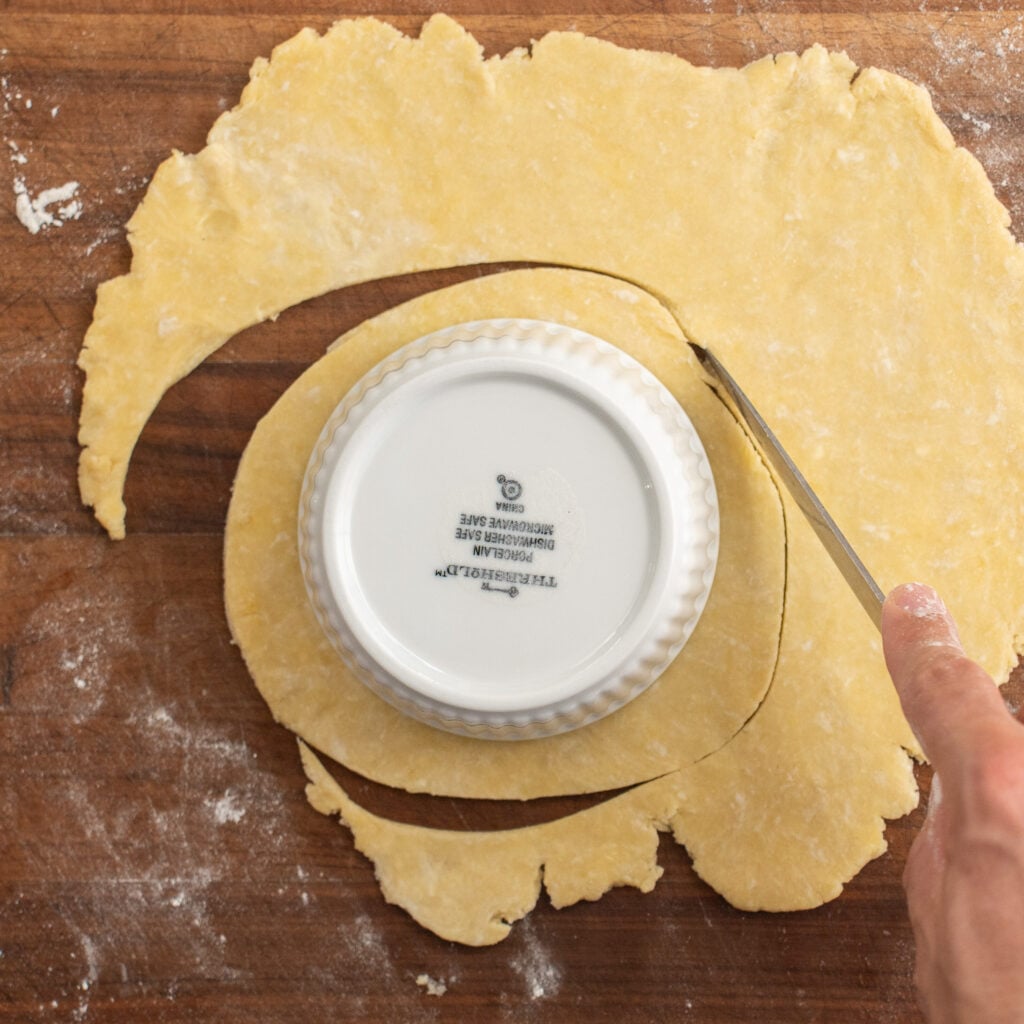
- Turn a 7-8 ounce ramekin upside down near one end of the dough. Cut a circle that’s 1-1½ inches wider than the ramekin on all sides for the bottom/sides of the pie. Next to it, use the ramekin itself to trace and cut a smaller circle for the lid. If there isn’t enough dough left for the lid, no worries, this dough is super user friendly. Just press the scraps together and re-roll gently.
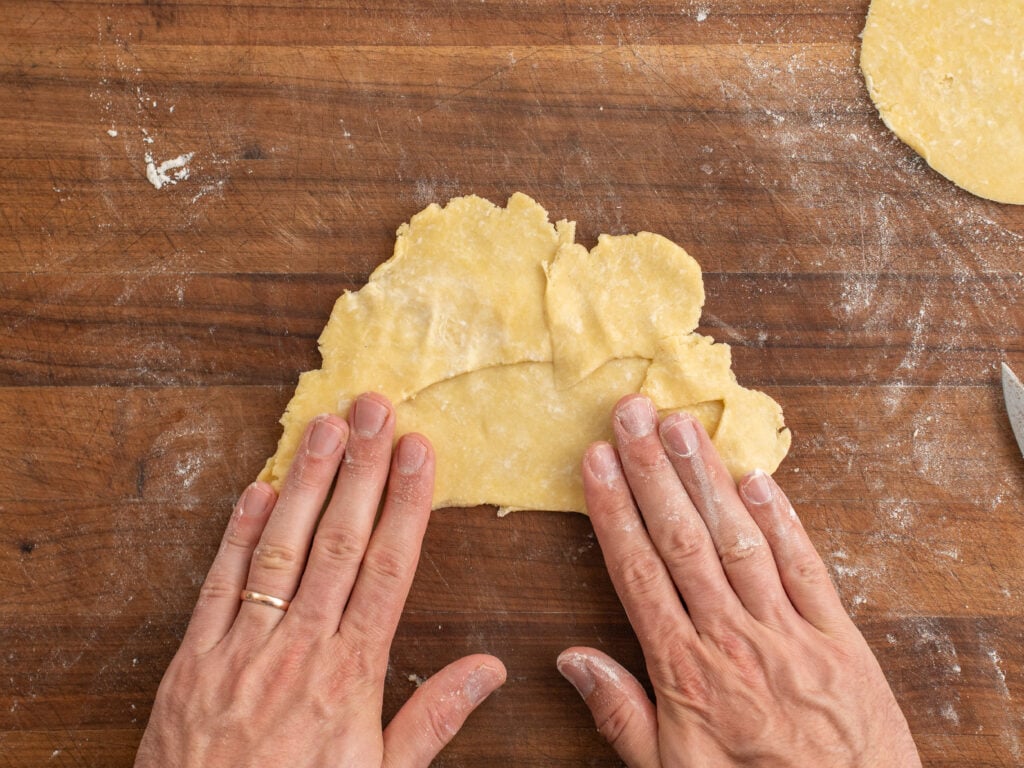
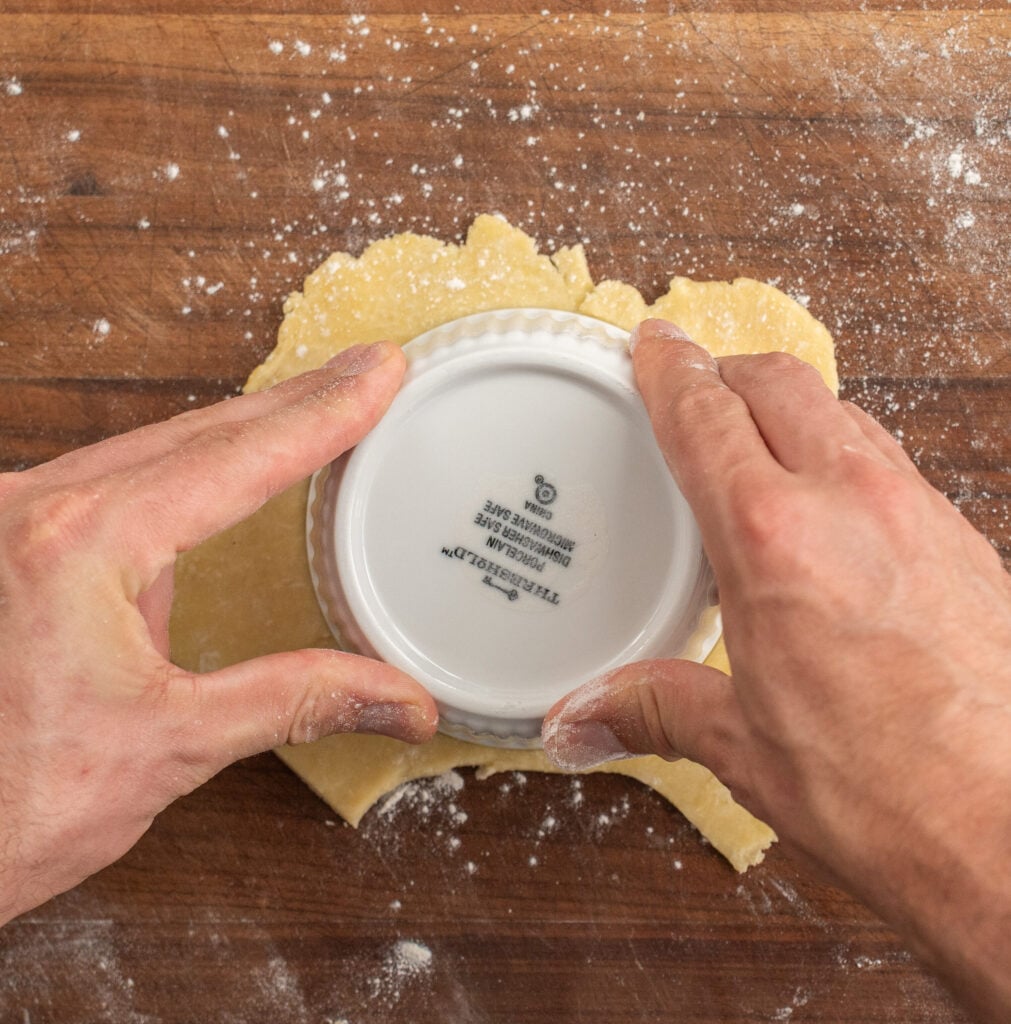
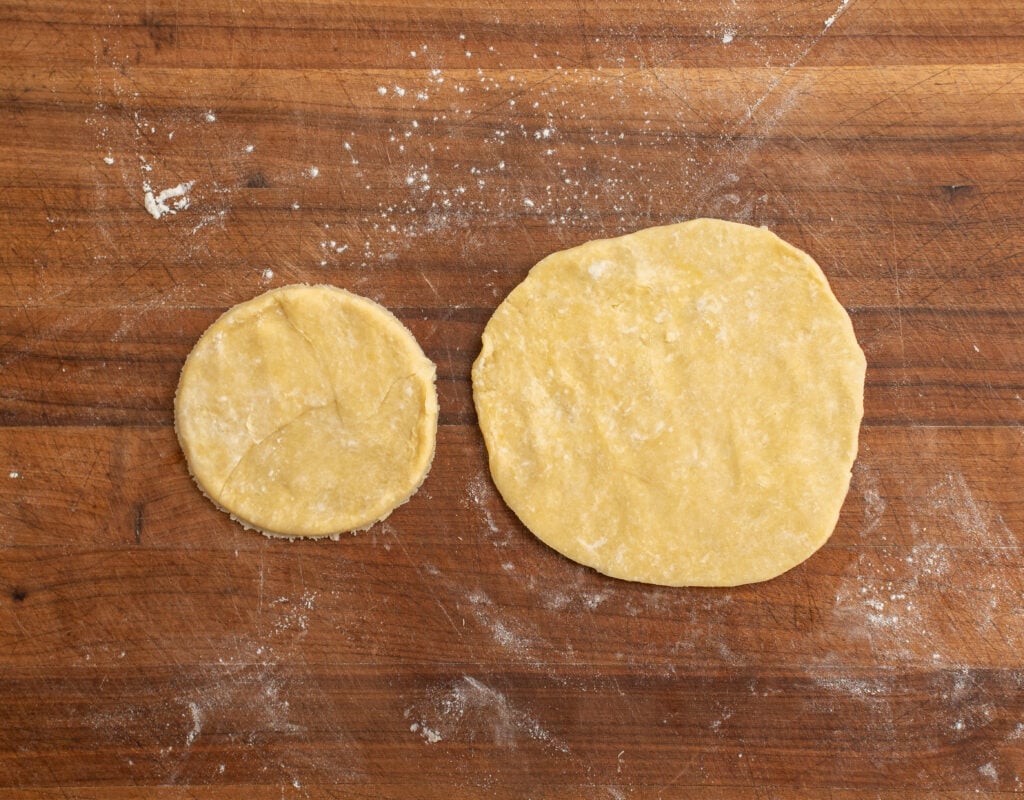
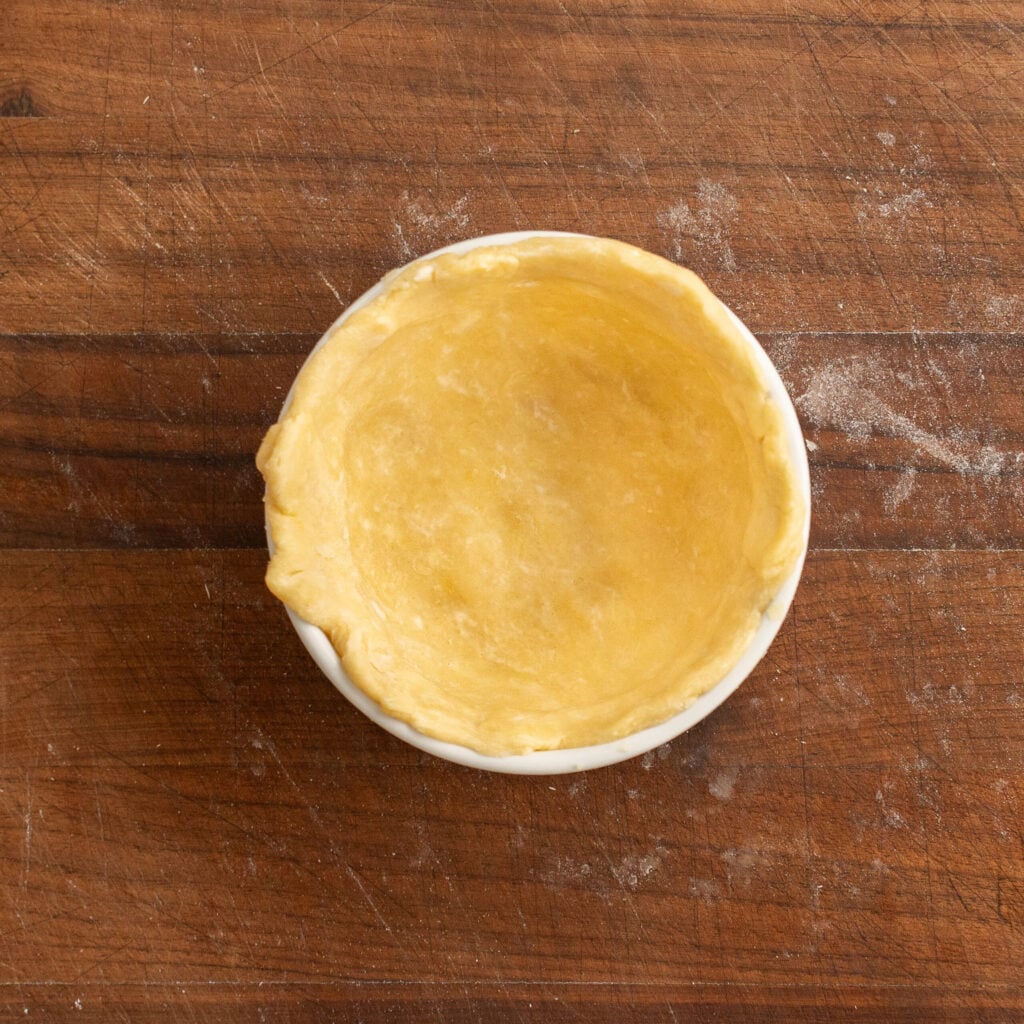
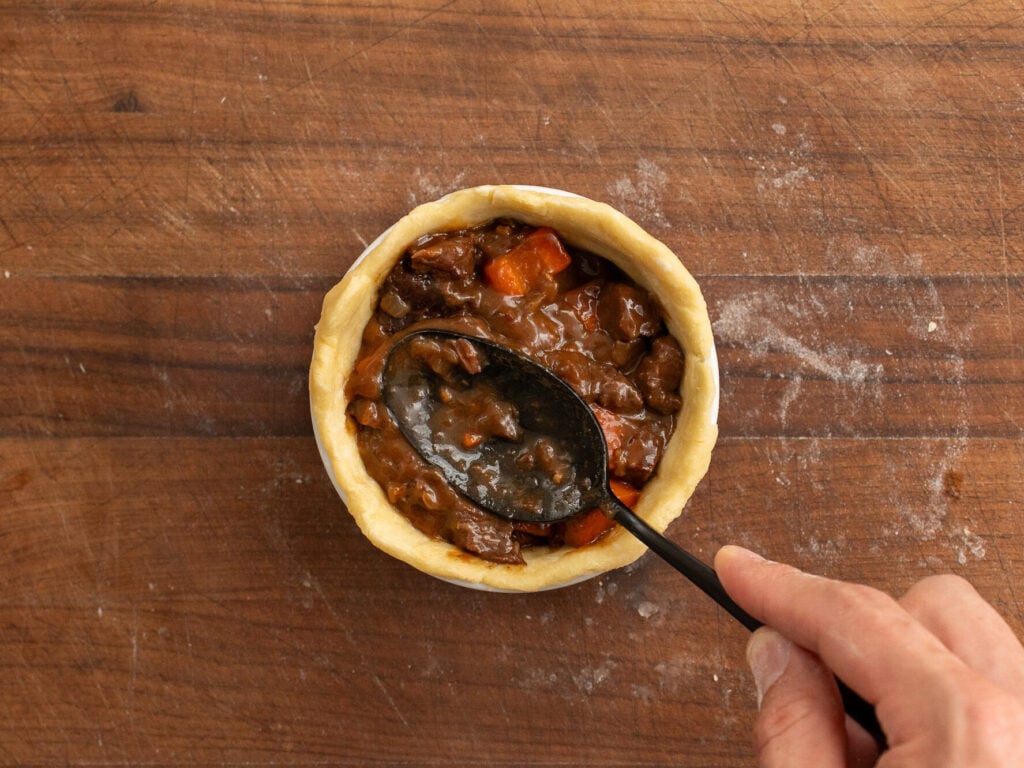
- Grease the ramekin with oil or pan spray, then press the larger round into the bottom and up the sides, smoothing out any trapped air. Add roughly 200g / ¾ cup of cooled stew, gently pressing to eliminate voids. It should come up to just below the top of the ramekin.
- Top with the smaller round and pinch the edges to seal tightly. Press the sealed edge down so it doesn’t stand too high above the ramekin, then poke or cut about a ½” hole in the top to vent. Brush with egg wash made from 1 egg whisked with 1 tablespoon of heavy cream or milk.
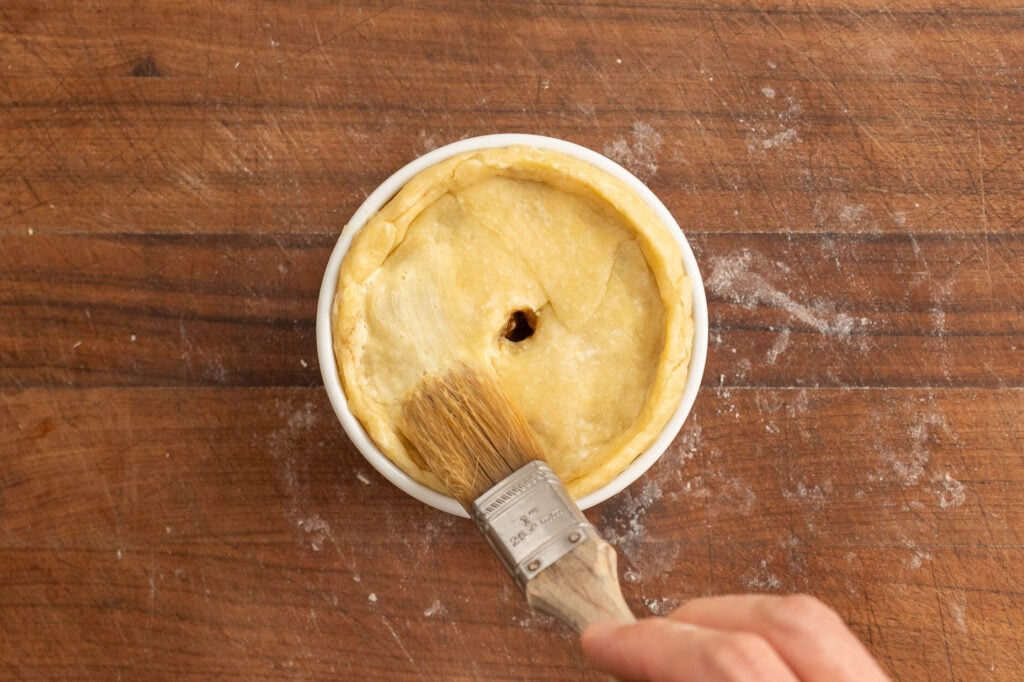
12. Bake. Load the pies into a 425°F / 220°C oven and bake for roughly 28-33 minutes, until quite dark. You’re looking for a deep, burnished brown color with well-set, crispy sides and tops. Keep in mind that this shell needs to contain the hot beef stew. If you underbake it, the crust will be soft and floppy instead of crisp and flaky.
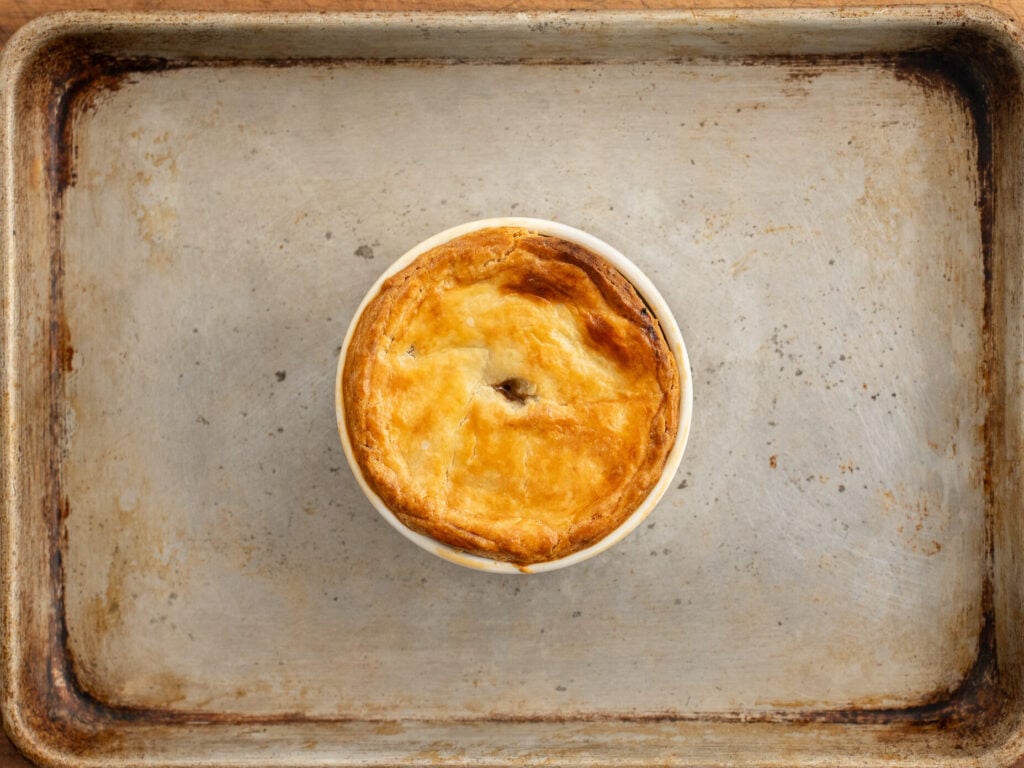
13. Rest and Serve. Let the pies rest 10 to 15 minutes. Straight out of the oven the filling is molten and runs everywhere. The rest lets the gelatin and roux tighten back up and firms the crust so it turns out of the ramekin cleanly. Serve with peas and roast potatoes or mash.
If you want additional gravy, here’s a link to my quick onion gravy.
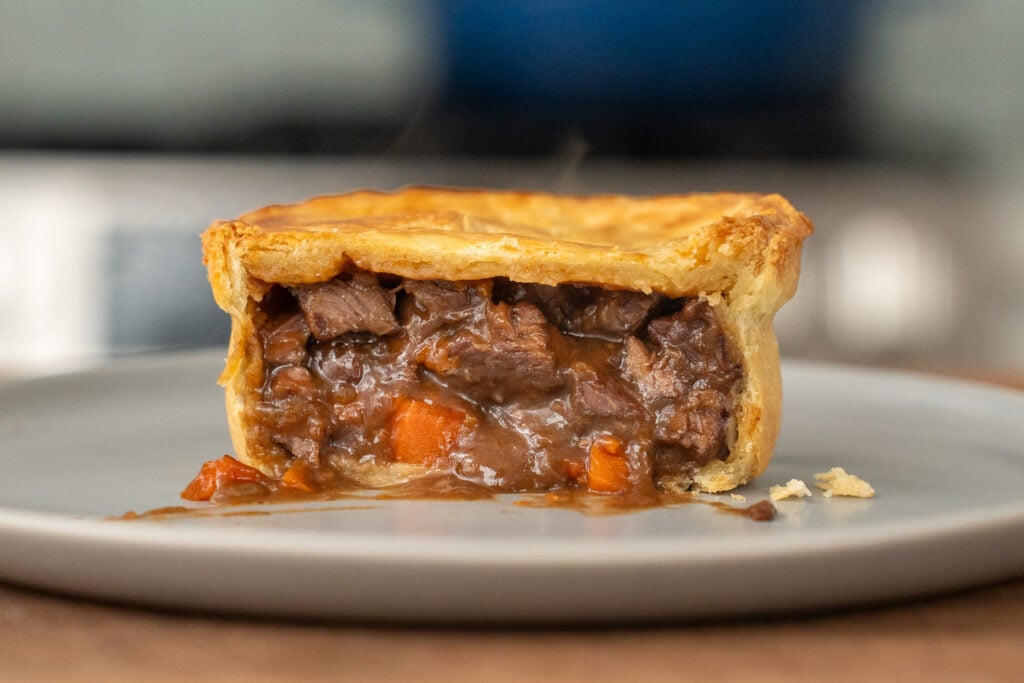
Storage, Make-Ahead, & Re-heating
The stew can be made ahead up to 3-4 days and kept in an airtight container in the fridge. The pies can be made ahead several hours to 3-4 days ahead.
When reheating pre-baked pies, use 325°F / 160°C for 15-20 minutes until hot.
More Recipes to Try:
- Biscuit Chicken Pot Pie – Savory and comforting filling topped with drop biscuits
- Peach Cobbler – Concentrated fresh peaches with golden buttermilk biscuits
- Sunday Roast with Yorkshire Pudding – Another British classic. Roast beef with crispy, golden Yorkshire puddings and rich pan gravy
Steak and Ale Pie
Ingredients
Beef Filling
- 2000 g beef chuck roast, trimmed and cut into ½" cubes
- coarse kosher salt
- oil , olive, avocado, canola
- 500 g onion, small diced
- 25 g garlic, minced
- 40 g tomato paste
- 60 g unsalted butter
- 60 g all-purpose flour
- 330 g red wine
- 440 mL Guinness
- 1,250 g beef stock
- 21 g unflavored powdered gelatin
- 15 g beef Better Than Bouillon
- 15 g Worcestershire sauce
- 400 g carrots, medium-large dice
- 6 sprigs fresh thyme
- 3 bay leaves
Pie Dough + Assembly
- 575 g all-purpose flour
- 10 g coarse kosher salt
- 35 g sugar
- 245 g cold unsalted butter, diced
- 165 g cold cream cheese, diced
- 1 egg
- 1 egg yolk
- 100 g cold water
- egg wash (1 egg + 1 T heavy cream, beaten)
Instructions
Day 1: Make Beef Filling
- Trim the hard white fat and sinew from a 4.5-5 lb chuck roast. Cut the remaining meat into ½-inch cubes. You'll be left with 1,200–1,300g trimmed beef. Toss with 2 strong pinches of salt and 2-3 tablespoons oil.
- Spread the beef in a single layer on a sheet tray. Broil about 6 inches from the heating element for 6-12 minutes, checking periodically, until the beef is a deep milk-chocolate brown. Set aside, reserving all the drippings.
- Heat 2-3 tablespoons oil in a 5-7 qt oven-safe pot over medium heat. Add diced onion and a pinch of salt. Cook, stirring occasionally, until translucent, about 6 minutes. Add minced garlic and cook for 60-90 seconds. Add tomato paste and 60g butter. Stir constantly for about 1 minute until the butter melts and the tomato paste turns rusty red.
- Stir in 60g all-purpose flour and cook for 30 seconds, stirring until no lumps remain. Pour in wine and Guinness, stirring and scraping up any browned bits from the bottom of the pot. Bring to a simmer and cook for 2-3 minutes.
- Whisk gelatin into room temperature beef stock. Add the stock mixture to the pot along with Bouillon and Worcestershire. Stir until smooth and bring to a simmer.
- Add the broiled beef, including all drippings, and diced carrots. Return to a simmer. Tie 5-6 thyme sprigs and 3-4 bay leaves into a cheesecloth sachet and add to the pot. Cover and braise in a 300°F (150°C) oven for 80-95 minutes.
- Check for doneness. The beef should shred easily when pulled apart with a fork but still hold its shape. If it's springy or tough, braise for another 15 minutes and check again. Avoid cooking it until it falls apart completely. Cool the stew at room temp until it's no longer hot then cover and refrigerate overnight.
Day 2: Finish the Filling
- Spoon off and discard most of the hardened fat from the top of the refrigerated stew. Warm stew gently until the liquid loosens. Remove the herb sachet, squeezing any trapped liquid back into the pot. Transfer the beef and carrots to a bowl using a spider or slotted spoon, allowing as much liquid as possible to drain back into the pot.
- Bring the remaining sauce to a strong, uncovered simmer over medium-high heat. Reduce for 15-20 minutes, stirring frequently and scraping the bottom and corners to prevent scorching. The gravy is ready when it's thick and glossy and a spatula dragged across the bottom leaves a visible trail for 1-2 seconds.
- Gently fold the beef and carrots back into the reduced gravy. If the sauce loosens noticeably, simmer for another 1-2 minutes to thicken. Taste and adjust with salt as needed. Remove from the heat and cool uncovered for 10-20 minutes, stirring occasionally until the filling is no longer hot enough to melt the butter in the pastry.
Make the Pie Dough, Assemble, and Bake
- In a 14 cup food processor, pulse 575g all-purpose flour, 10g salt, and 35g sugar to combine. Add 165g cold, diced cream cheese and pulse about 15 times. Add 245g cold, cubed butter and pulse another 10-15 times. Remove the lid and distribute 100g cold water, 1 egg + 1 egg yolk (beaten) evenly over the mixture. Replace the lid and pulse several more times, scraping the bowl halfway through, until the ingredients are evenly incorporated. Avoid overmixing.
- Divide the dough into six equal
≈ 200g portions. Flatten each into a thick rectangle, wrap tightly, and refrigerate for 20-30 minutes. You can prepare the dough while the gravy reduces to save time. - After chilling, lightly flour both sides of one dough rectangle and your rolling pin. Roll 3-4 times, rotate 90 degrees, flip it over, and repeat until the dough is approximately ⅛ inch thick and 10 × 8 inches.
- Place a 7-ounce ramekin upside down near one end of the dough. Cut a circle approximately 1–1½ inches wider than the ramekin on all sides for the bottom crust. Next to it, use the ramekin to mark and cut a second, smaller circle for the lid. If needed, press the scraps together to make the lid.
- Grease the ramekin with butter or pan spray then press the larger dough circle into the bottom and up the sides, removing any trapped air. Add approximately 200g (¾ cup) cooled beef filling and press gently to eliminate gaps. Top with the smaller circle and pinch the edges firmly to seal. Press the sealed edge down so it doesn't stand too far above the rim. Cut a vent in the center of the lid and brush with egg wash made from 1 egg whisked with 2 tablespoons heavy cream or milk. Repeat with the remaining dough and filling.
- Place ramekins on a sheet tray and bake in a preheated 425°F (220°C) oven for 28-33 minutes until the pastry is deeply golden brown and the tops and sides are well set and crisp.
- Let the pies rest for 10-15 minutes before carefully removing them from the ramekins.
 Like this? Leave a comment below!
My Go-To Gear
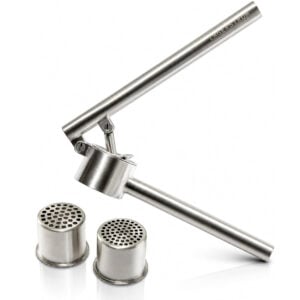
Below are the tools I use when making this recipe. Some of these are affiliate links, which means I may earn a small commission if you purchase through them at no extra cost to you.

Frequently Asked Questions
Yes. Use Guinness 0.0 in place of the regular Guinness, and swap the red wine for 50/50 beef stock and apple juice. That will bring back some of the acid and fruitiness the wine was providing.
I’d buy a store-bought pie crust for the bottoms and top them with store-bought puff pastry. Or put the filling in a cast iron pan like we did for the biscuit pot pie and top it with store-bought puff pastry sheets.
Same day works. Skip the overnight chill and skim the fat off the hot liquid with a ladle instead of lifting off a solid cap. The filling still has to cool a bit before it goes into the dough though, so build in time for that.
Usually one of three things. 1. You overfilled it. You want to fill just up to the rim or slightly below. Any more and it leaks at the seams. 2. The seal wasn’t tight. 3. You skipped the vent in the top. The filling throws off a lot of steam in the oven, and with no vent it blows out through the seams.






This looks super dope. The challenge with this kind of dish is, my partner is celiac – so the beer and the crust are an issue. I’ve given up finding a way to make the exact gravy, tbh, but we manage a decent pie crust. None that use cream cheese, though. Any thoughts on how to replicate what the Guinness does in a GF way?
Brian recommends swapping Guinness for a medium bodied medium hopped GF beer like red ridge. After all the reduction you won’t see much of a difference.
The color may not be as dark chocolate but if you close your eyes you won’t be missing out on much flavor. Will still be good. No real way to replicate roasted malt, but you can possibly use a small splash of molasses. You don’t want extra sweetness so use it sparingly. As for the AP flour sub, use cup for cup like bob’s red mill. it SHOULD be fine, but may break after a lot of reduction